
Spectral Classification
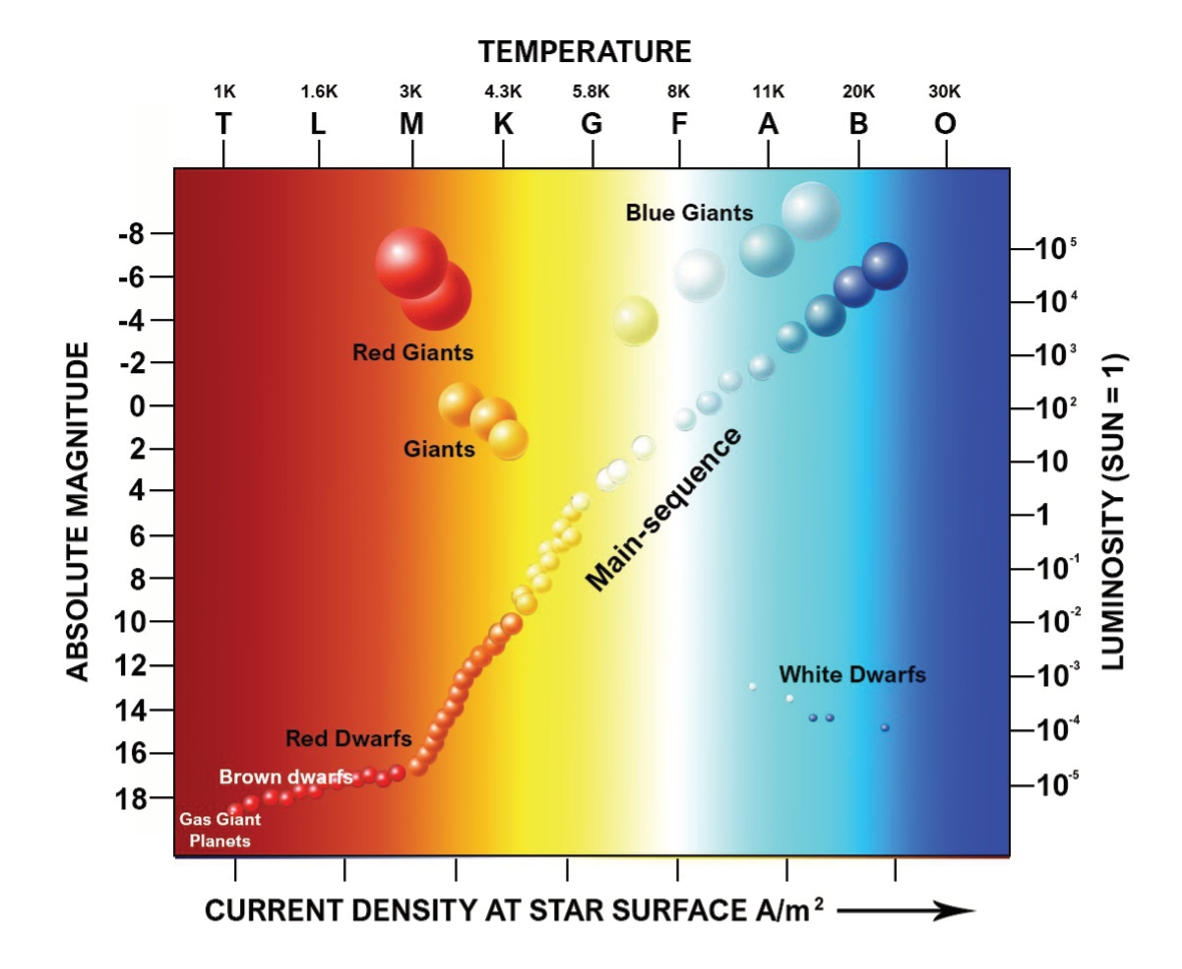
Stellar spectral classification is the system astronomers use to categorize stars based on their spectral characteristics and temperatures. Starlight passing through a prism or spectrograph breaks down into a spectrum interspersed with unique absorption lines that serve as a chemical fingerprint related to the star's temperature.
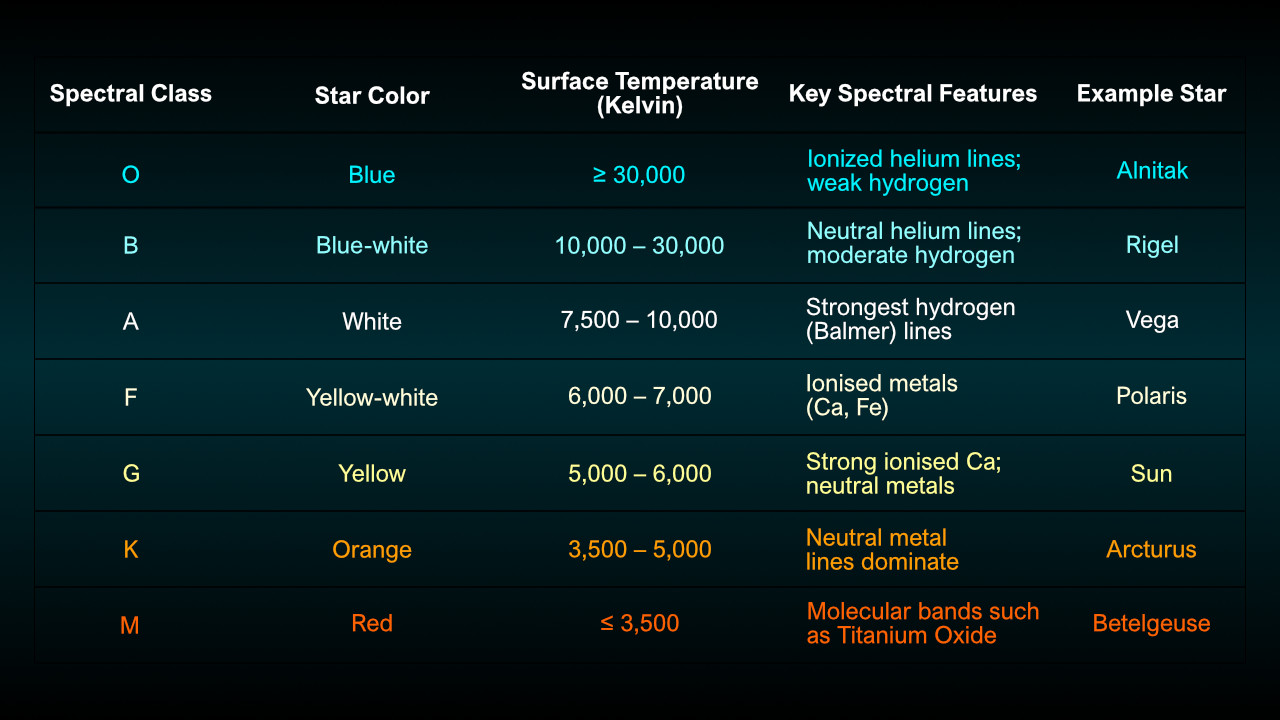
Astronomers use the Morgan–Keenan (MK) system, which combines the temperature-based Harvard classification—the letters T, L, M, K, G, F, A, B, O—with a Roman numeral luminosity class to define a star's size. Spectral class O is the hottest, and T is the coolest.
Unlike the standard Hertzsprung-Russell diagram used by mainstream astronomers, the Electric Universe uses the above, more accurate one, connecting temperature with the star's surface current density.
The Primary Spectral Classes (Harvard System)
Luminosity Classes
Two stars can have the same temperature (and letter class) but radically different sizes and energy outputs. The MK system resolves this by checking absorption line widths. Denser, compact stars such as dwarfs have wider, blurred lines because the lower corona reaches down to the photosphere, while massive stars have very sharp, narrow lines.
Astronomers append Roman numerals to designate these stages:
- Ia+ / 0: Hypergiants
- I (Ia, Ib): Supergiants
- II: Bright Giants
- III: Regular Giants
- IV: Subgiants
- V: Main-Sequence Dwarfs
- sd / VI: Subdwarfs
- D / VII: White Dwarfs
System Extensions
The classification framework has been expanded to encompass rarer or cooler cosmic objects:
W (Wolf-Rayet stars): Highly luminous, massive stars with intense electrical stress.
C & S (Carbon & Heavy Metal stars): Cool giants exhibiting anomalous chemical atmospheric abundances.
L, T, and Y: Classes reserved for brown dwarfs and ultra-cool exoplanets.