
Spectral Class C Carbon Stars in an Electric Universe
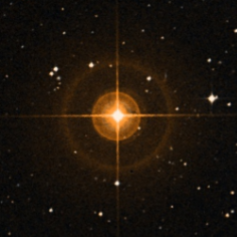
Spectral class C carbon stars – R Leporis is an example.
Spectral class C carbon stars: Hind's Crimson Star (R Leporis) and La Superba (Y Canum Venaticorum) are examples.
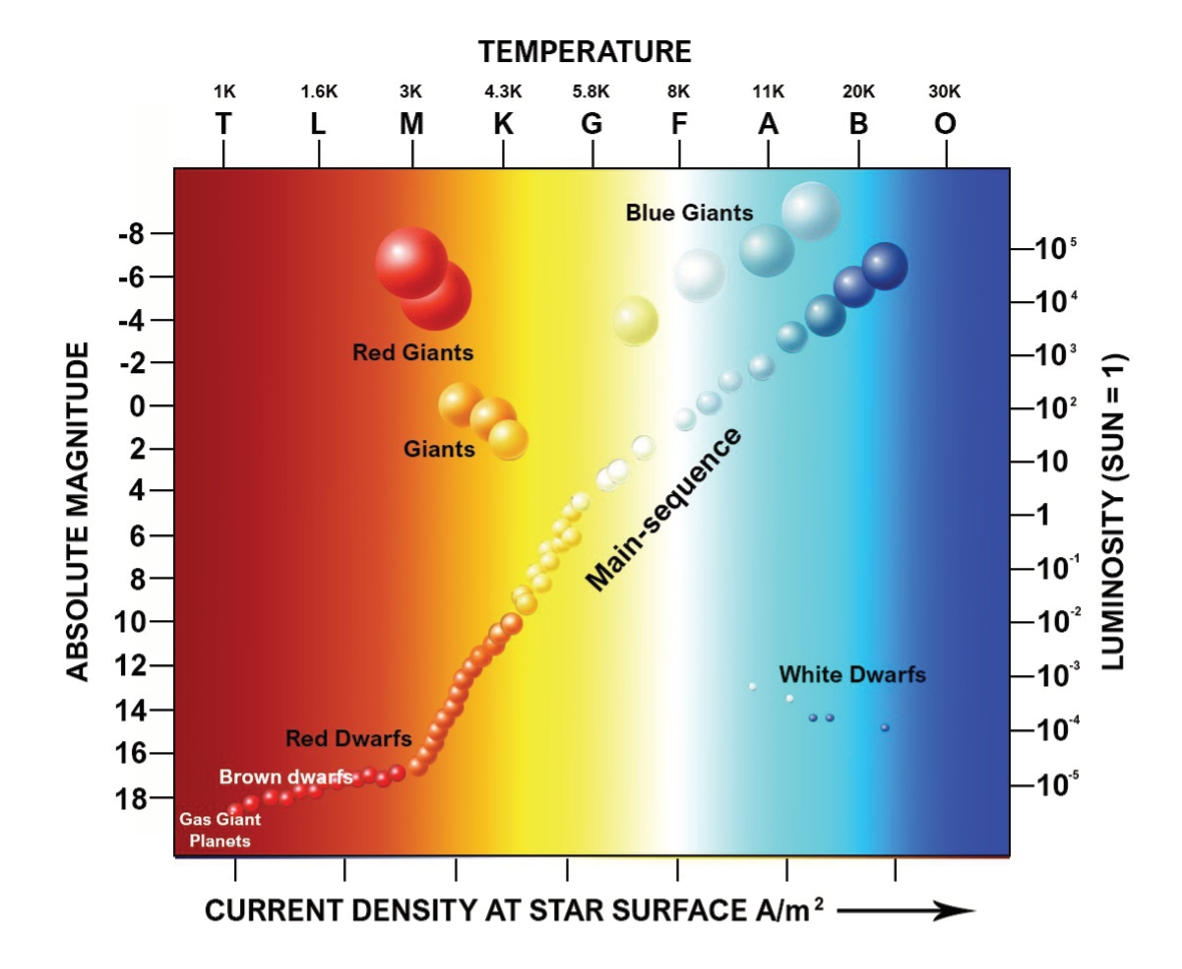
Discharge Mode for Class C Carbon Stars
If the atmospheres of red giants are cool enough to form molecules, their characteristic light signatures exhibit strong bands of titanium oxide (TiO). Some cool stars have spectra dominated by carbon-containing molecules, such as CH, CN, and C2. These rare spectral features show that carbon is more abundant than oxygen. These are carbon stars.
Most of the coolest red giants are oxygen-rich class M stars. The carbon-rich ones are designated class C carbon stars. Even rarer are class S stars, which have roughly an equal number of oxygen and carbon atoms.
The galactic Birkeland currents powering these stars are weaker than those powering red giants, so their glow-mode plasma shines with a deeper red hue.
In the late 1990s, astronomers updated the classification system to replace the independent R and N classes with a unified C system to better reflect the stars' physics.
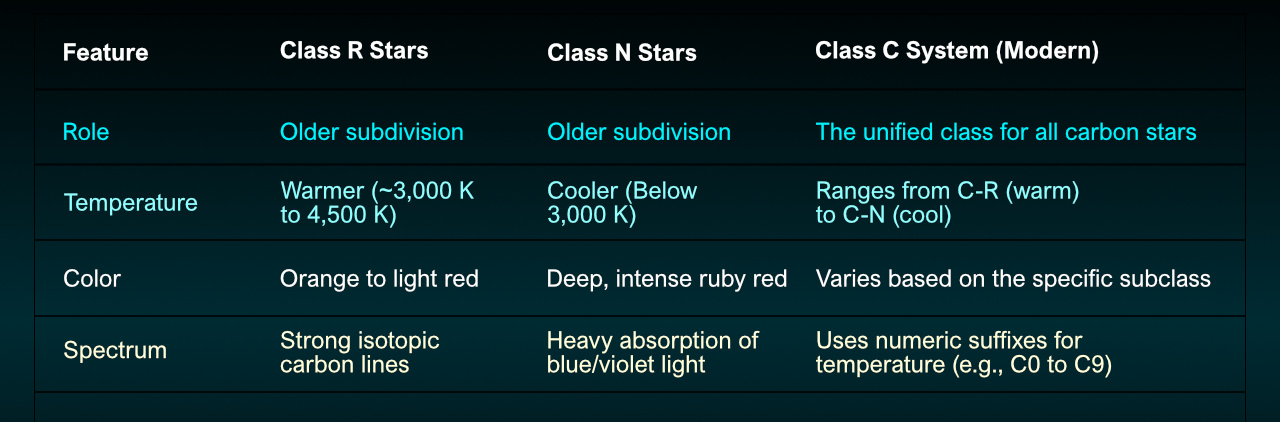
Class C (The Umbrella): Historically, carbon stars did not fit neatly into the standard O-B-A-F-G-K-M sequence. The modern C system fixes this by grouping all stars with more atmospheric carbon than oxygen together, using subdivisions like C-R, C-N, C-J, and C-H to specify their exact chemical quirks.
Class R (The Warmer Giants): These are equivalent to standard class K or early class M stars in temperature, but with an excess of carbon. Because they are warmer, they do not suffer from the extreme blue-light absorption seen in cooler stars, so they appear orange or light red.
Class N (The Coolest Giants): These are the classic "ruby red" stars. Equivalent to late class M stars in temperature, they are so cool that carbon molecules easily form in their atmospheres. These molecules aggressively block blue and violet light, allowing only the deepest red wavelengths to escape.