
Spectral Class M Red Giant Stars in an Electric Universe
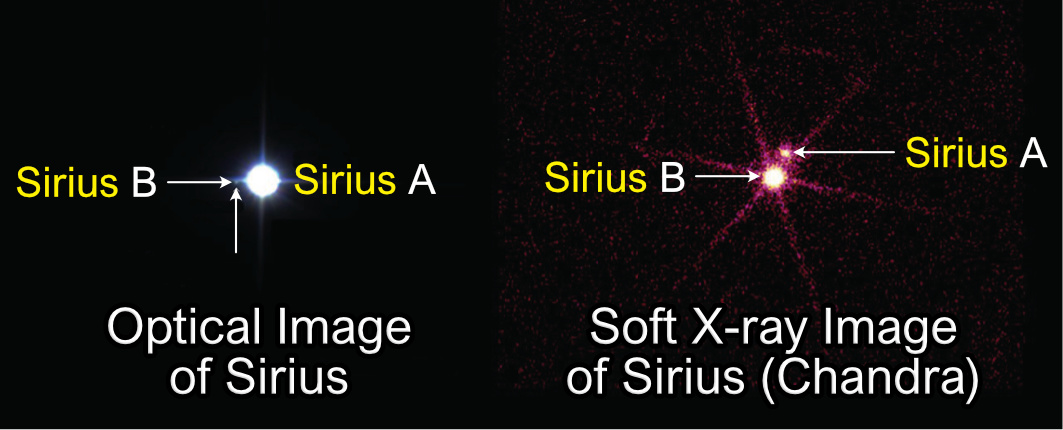
Chandra image of the white dwarf stars – the Pup star, Beta Canis Majoris
Spectral class D stars include white dwarf stars, like the Pup Star orbiting Sirius in Canis Major.
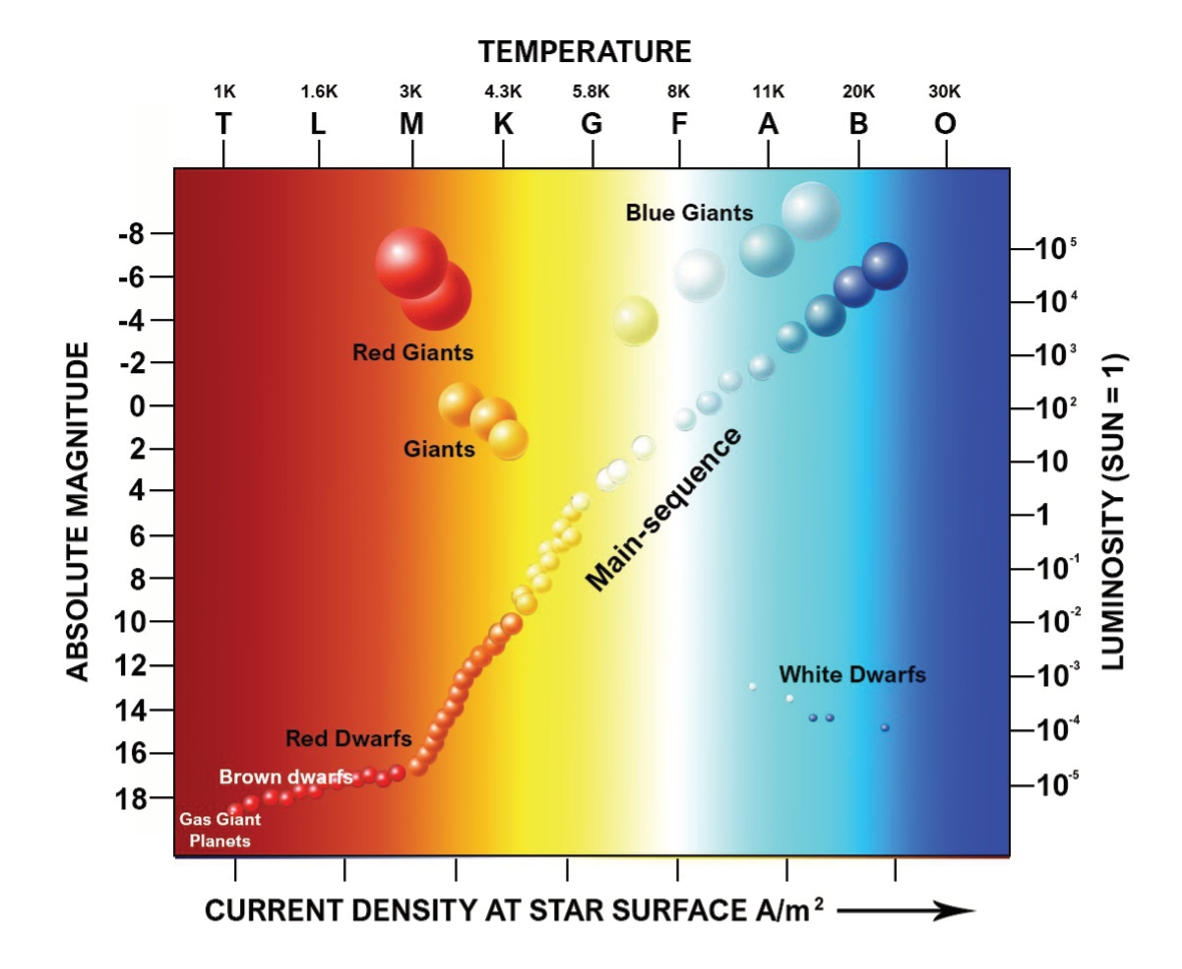
Discharge Mode for Class D White Dwarf Stars
Low electrical stresses: White dwarf stars are those that are under low electrical stress, so that bright anode tufting is not required. The stars appear extremely hot, white, and under-luminous because it is equivalent to having the faint white corona discharge of the Sun reaching down to the stellar atmospheres.
Thin plasma sheath: A thin plasma sheath forms between the plasma of the star and the plasma of space. The electric field across this sheath accelerates electrons to generate X-rays when they hit atoms in the atmosphere. The power dissipated can raise the temperature of a thin plasma layer to tens of thousands of degrees.
Multiple star systems: White dwarf stars occur in multiple star systems when the brighter primary star usurps most of the electrical power, dissipating the energy in optical wavelengths. The white dwarf converts its share of power most efficiently into X-rays.
See twinkle, twinkle, electric star.The Mainstream View of Class D White Dwarf Stars
A white dwarf is the dense, dead stellar remnant of a low- to intermediate-mass star that has exhausted its nuclear fuel.
White Dwarf Stars: Formation and Structure
Origin: Stars with initial masses below roughly 8 times that of our Sun spend most of their lives fusing hydrogen into helium.
Red Giant Phase: Once core fuel runs out, the star expands into a red giant and eventually sheds its outer layers into a planetary nebula.
The Remnant Core: The exposed hot carbon-oxygen or helium core is left behind as a white dwarf.
Physical Characteristics
Size: Comparable to Earth (roughly 1% of the Sun's radius).
Mass: Typically, around 0.5 to 0.7 solar masses (capped by the Chandrasekhar limit at approximately 1.44 solar masses, beyond which electron degeneracy fails).
Density: Immensely dense, with a teaspoon of its matter weighing tons on Earth (densities reaching roughly 1,000,000 times that of water).