
Benjamin Apthorp Gould's Uranometria Argentina
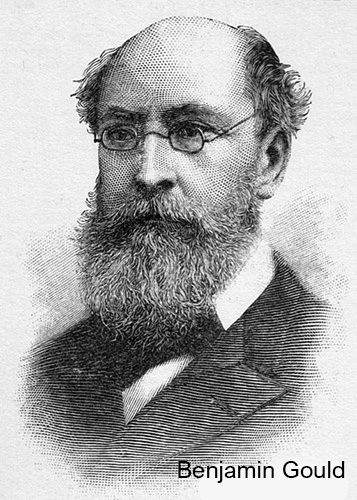
Benjamin Apthorp Gould’s Uranometria Argentina was one of the most important nineteenth-century surveys of the southern sky. Produced at the Argentine National Observatory at Córdoba, its atlas appeared in 1877, and the accompanying catalogue was published in Buenos Aires in 1879. The catalogue contained 7,756 stars between the south celestial pole and declination +10°. It included all stars that Gould estimated to be magnitude 7 or brighter, together with some fainter stars that were close companions of brighter stars, or members of close pairs whose combined brightness reached approximately seventh magnitude.
The positions of the stars were given for the equinox of 1875.0. Gould also tried to resolve the considerable uncertainty then surrounding the boundaries of the southern constellations. He defined boundaries throughout the region covered by the catalogue, generally using arcs of right ascension and parallels of declination while attempting to preserve the traditional constellation membership of prominent stars. Gould’s work subsequently became an important basis for Eugène Delporte’s definitive system of constellation boundaries, adopted by the International Astronomical Union and published in 1930. Delporte retained the 1875.0 equinox used by Gould, although some of Gould’s boundaries were modified to produce a consistent system covering the entire celestial sphere.
Within each constellation, Gould assigned numbers to stars of approximately seventh magnitude and brighter, normally in order of increasing right ascension at epoch 1875.0. In a few instances the sequence was adjusted so that stars lying close together could appear on adjacent lines in the catalogue. The principle was similar to that employed by John Flamsteed for the stars of the northern constellations, and these identifiers subsequently became known as Gould numbers. To distinguish them from Flamsteed numbers, they are conventionally followed by the letter G; thus, a designation such as 39 G. Sgr identifies Gould number 39 in Sagittarius.
Although Gould numbers are seldom encountered in modern astronomical literature, they remained in use well into the twentieth century. They appeared in the American Ephemeris and Nautical Almanac until 1978 and were retained in the FK5 catalogue material until 1999. Gould’s numbering therefore provided the southern sky with a useful counterpart to the much better-known Flamsteed numbering system of the northern constellations.
Modern comparisons with accurate photoelectric measurements show that Uranometria Argentina is nearly complete to magnitude 6.5 across its declination range. This makes the catalogue particularly valuable not only as a historical record of nineteenth-century southern astronomy, but also as a systematic inventory of the naked-eye stars of the southern heavens.
A modern electronic edition of Uranometria Argentina is available through the CDS/VizieR astronomical catalogue service. Its principal catalogue contains every star listed in Gould’s original work. Whereas Gould arranged the constellations according to increasing distance from the south celestial pole, the electronic edition rearranges them alphabetically for convenience while retaining Gould’s original ordering of the stars within each constellation.
The electronic edition also provides J2000 coordinates and cross-identifications with other major catalogues, including the Flamsteed, Henry Draper (HD), and Smithsonian Astrophysical Observatory (SAO) catalogues. Extensive accompanying notes identify individual stars and groups of associated stars. Corrections published by Gould in Astronomische Nachrichten in 1887 and by Thomas William Backhouse in The Astronomical Journal in 1892 have also been incorporated, together with a small number of additional typographical corrections identified during the preparation of the modern electronic catalogue.