
Blue Giants and Subgiant Stars in an Electric Universe
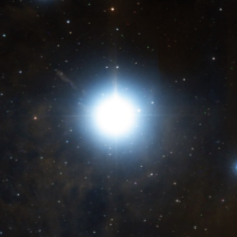
Rigel, one of the blue giants, is in the constellation of Orion
Here is the 'electric star' framework for class B blue giants and subgiants—the hot, blue-white end of the spectral sequence:
Spectral Class K Orange Giants
Discharge Mode
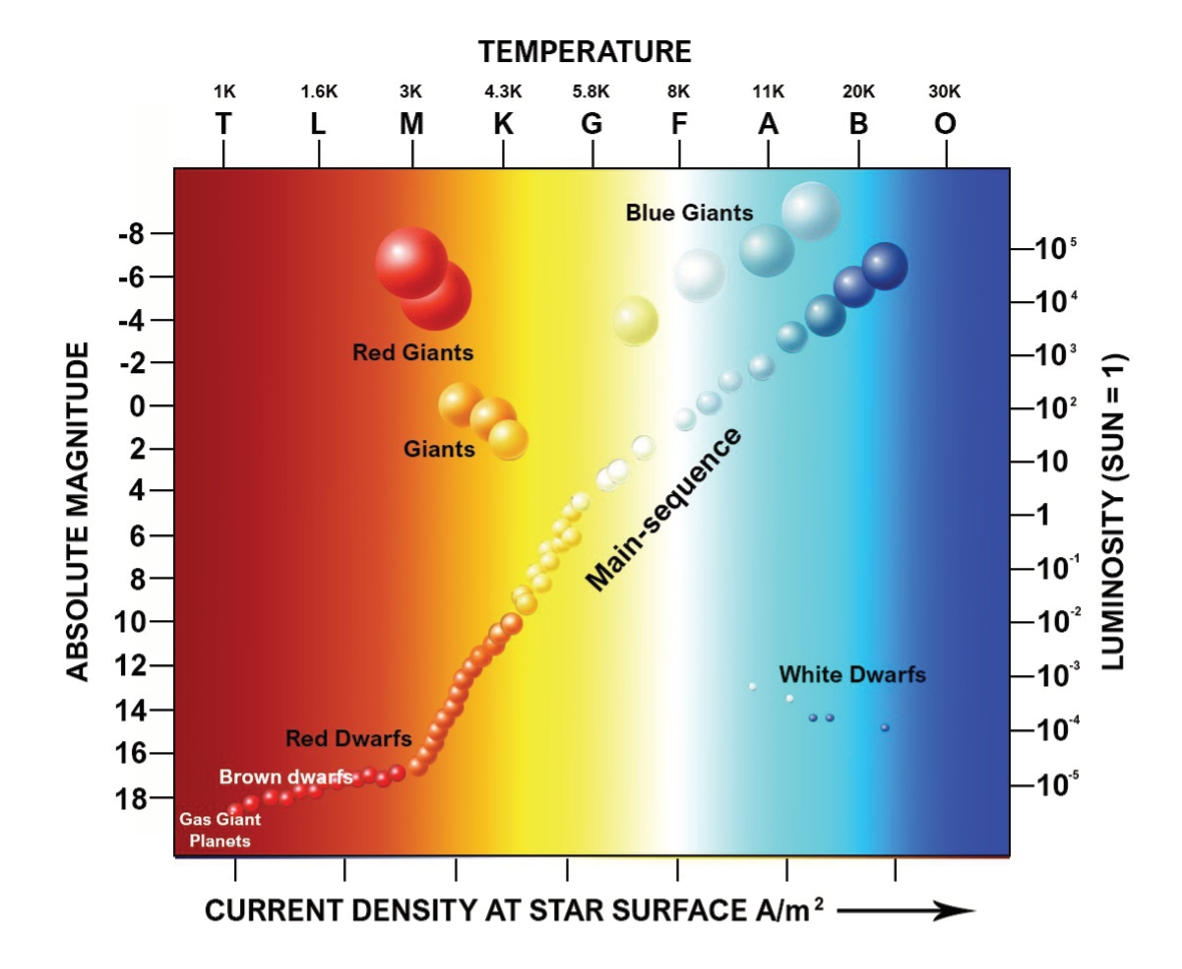
In the EU model, spectral class tracks position along the current-voltage (glow-to-arc) curve of the galactic Birkeland circuit a star is embedded in, rather than mass and core temperature. Class B blue giants—hot, blue-white, high luminosity—are placed at the high-current-density end of that curve, in or approaching arc-mode discharge, the most energetic and visually intense regime EU proponents describe (as opposed to the more diffuse glow-discharge modes proposed for cooler K/M stars).
Color/Temperature
The blue-white color is attributed directly to the intensity of the arc discharge in the surrounding plasma sheath: higher current density produces a hotter-appearing, bluer glow, by analogy to laboratory plasma arcs and discharge tubes, where color shifts with current density and gas composition.
Size (giant/subgiant distinction)
Mainstream astrophysics treats class B blue giants and subgiants as intermediate- to high-mass stars that have exhausted (or are exhausting) core hydrogen and are expanding as they evolve off the main sequence, with subgiants marking the early expansion phase and giants further along the shell-burning track.
In the EU framework, the different radii are attributed to differences in the extent or density of the plasma discharge sheath: a larger apparent radius reflects a more extended (lower-density) glow around the same current-carrying core, rather than a change in internal nuclear-burning state.
EU Evidence Required
This is actually one of the more challenging cases for the EU model to account for.
Class B blue giants and subgiants are comparatively short-lived and rare in the mainstream picture because massive-star evolution off the main sequence proceeds quickly—a prediction that follows directly from the mass-luminosity relation and nuclear timescales.
The EU model has no equivalent quantitative reason why this particular class should be rare, since discharge mode alone does not predict population statistics or lifetimes.
These stars show strong, well-resolved spectroscopic signatures such as line broadening and, in some cases, asteroseismic pulsation data for the subgiants, consistent with the standard post-main-sequence structural models. An account grounded in discharge-mode intensity does not independently generate matching log g and luminosity values without effectively re-deriving the mainstream numbers after the fact.
In mainstream theory, stellar surface gravity log g and luminosity (L) are key properties used by astronomers to classify stars and understand their evolutionary stages on the Hertzsprung-Russell diagram. Log g represents surface gravity. The base-10 logarithm of the gravitational acceleration at a star's surface (g = G M / R²), is measured in CGS units (cm/s²). Typical values range from about log g = 0 for massive supergiants to log g = 5 for dense dwarfs.
EU theory proposes that gravity is a dipolar electrical phenomenon that varies with the value of the assumed ‘gravitational constant,’ G, which depends on the electric field strength in a star system. G is not a universal constant. In fact, it is the least constant of all the constants in physics. The value of G here on Earth cannot be used in other star systems because the strength of the powering Birkeland current is not known. So, all those log g values for different stars are highly likely to be inaccurate.
Some class B blue giants such as Beta Cephei-type pulsators show pulsation periods tightly matched by opacity-driven kappa-mechanism models (an opacity-driven thermodynamic feedback loop that acts as a heat engine to drive pulsations in variable stars) tied to internal ionization zones—a specific mainstream prediction that a surface-discharge model would need a separate mechanism to reproduce.
While the ‘current density → color/size’ mapping in EU theory is qualitatively correct, it has yet to close the gap on the quantitative side. That is a task for EU theory proponents to do and to eventually get published.