
Spectral Class A Stars in an Electric Universe
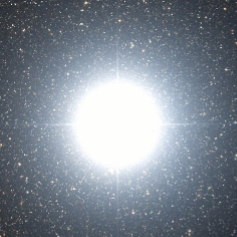
A typical spectral class A star, Altair, Alpha Aquilae
Here is the 'electric star' framework for class A stars—the white and bluish-white part of the spectral sequence:
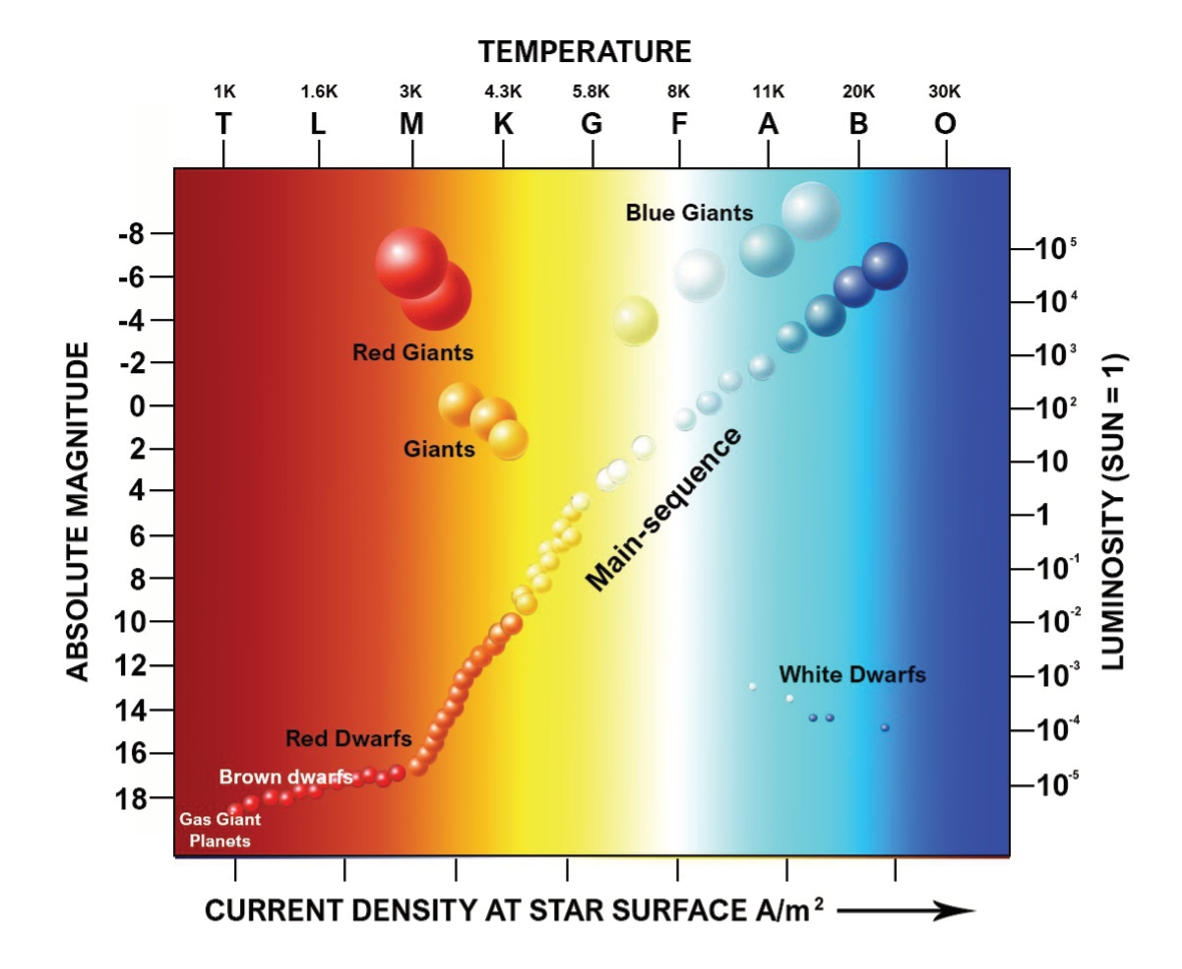
Spectral Class A Stars
Discharge Mode and Rotation
Spectral class A stars sit between the arc-mode class B stars and the cooler class F/G stars on the Electric Universe (EU) current-voltage curve—a moderately high-current regime that produces the characteristic white and bluish-white colors of these rapidly rotating plasma balls.
Stellar Oblateness
Mainstream says that rapidly rotating class A stars, such as Altair in Aquila, have extreme equatorial bulging and gravity darkening, with the equator being cooler and dimmer than the poles due to lower effective surface gravity there.
In the EU framework, this is interpreted not as a hydrostatic/rotational-flattening effect. It is evidence of a non-uniform discharge across the stellar surface. It is a plasma body responding to external current flow, showing discharge-intensity gradients between the poles and equator, with the poles (aligned with the presumed current axis) running hotter as higher-density discharge zones and the equatorial bulge treated as a lower-density glow region.
The Mainstream View of Class A Stars
Interferometric observations directly confirm the oblateness and gravity-darkening trend predicted for rapidly rotating stars such as Vega and Altair, although detailed measurements show departures from the simplest classical von Zeipel prescription.
The Swedish astronomer Edvard Hugo von Zeipel formulated the von Zeipel gravity-darkening law in 1924. It shows that the emerging radiative flux (F) and effective temperature (Teff) scale with the local effective gravity:
Flux: F ∝ geff
Asteroseismology
Asteroseismology of some Class A stars, such as pulsating Delta Scuti variables, which overlap with this rapid-rotator population, constrains internal rotation profiles and structure in ways tied to acoustic mode physics inside a stratified, gravitationally bound star. There is no established EU-side treatment of these pulsation frequencies.
Rapid Rotation
Rapid rotation in class A stars correlates with the presence or absence of the chemically peculiar Am/Ap phenomenon (slow rotators show strong chemical peculiarity). Mainstream says this is from radiative levitation and gravitational settling; fast rotators do not, because rotational mixing washes it out. This is a well-worked mainstream link between rotation rate and atmospheric physics. An EU account needs a separate mechanism to explain this.
However, remember that the mainstream treats stars as hydrodynamic fluids. Plasma balls obey different rules. It is less about population statistics and more about the EU's discharge-gradient reframing needing to match a hydrodynamic law (von Zeipel) that has already been independently confirmed to good precision by direct interferometric imaging—that is a stiffer quantitative bar than the giant-branch color-luminosity relation used in EU theory.