
Spectral Class F Stars in an Electric Universe
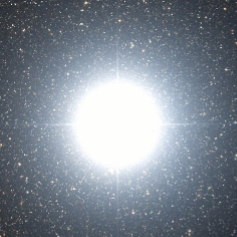
A typical spectral class A star, Altair, Alpha Aquilae
Here is the 'electric star' framework for class F stars—the white-yellow part of the spectral sequence:
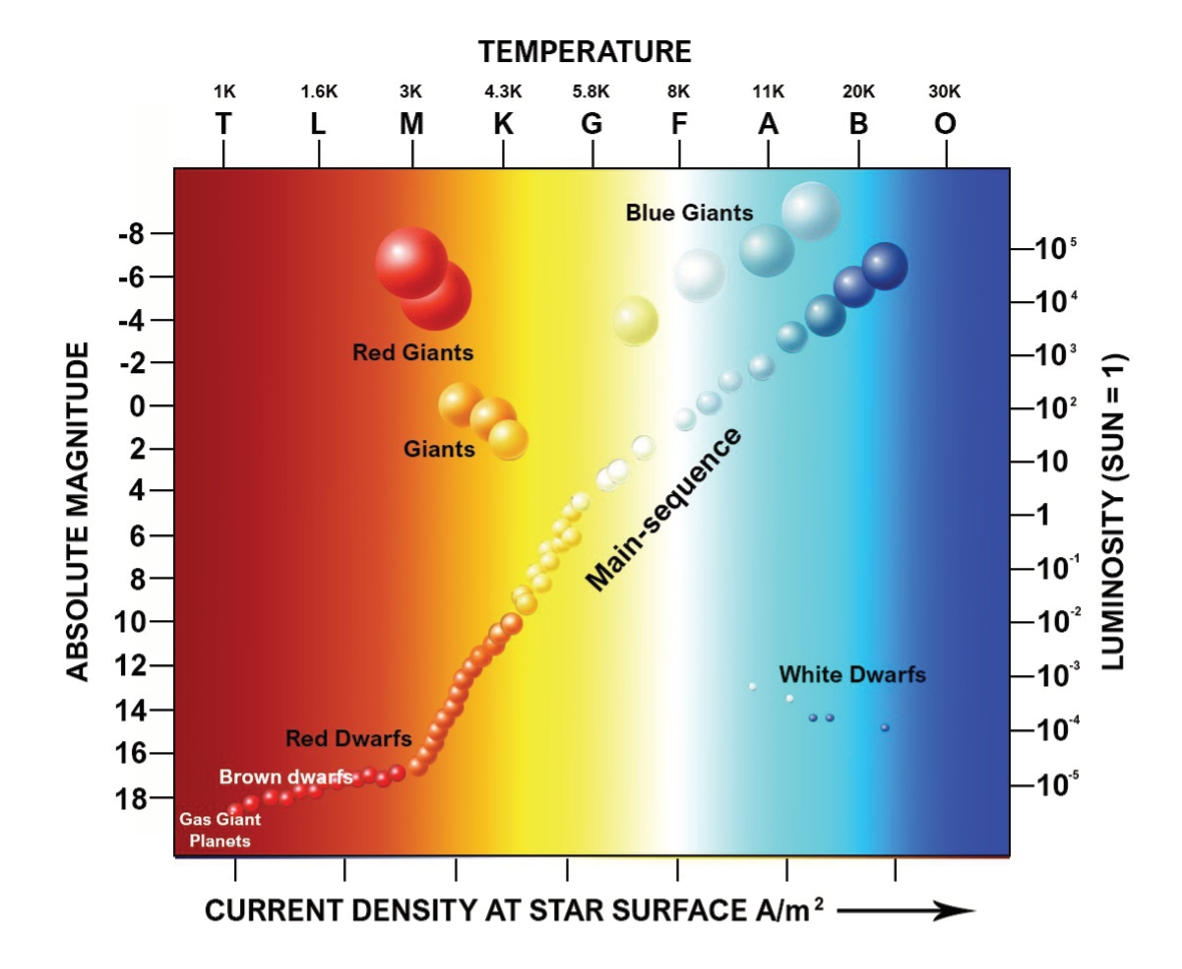
Spectral Class F Stars
Discharge Mode and Position on the Curve
Class F stars occupy a middle position on the Electric Universe (EU) current-voltage curve, in what is generally described as a transitional zone between the higher-current arc-mode discharge of class A/B stars and the more diffuse glow-discharge regime attributed to class G and K stars.
The white-yellow color is treated as a direct readout of moderate current density—less intense than the blue-white arc of A stars, but still well above the cooler arc and glow discharge proposed for the Sun, and the glow mode discharges of orange and red stars.
The Granulation Issue
The EU reframing treats granulation-like surface structure as evidence of discharge cells or filamentary current structures at the photosphere, by analogy to the cellular patterns seen in laboratory glow-discharge experiments, the SAFIRE Project, and Kristian Birkeland's terrella experiments. However, it does not independently predict where in the spectral sequence that cellular pattern should appear or disappear the way convection-zone-depth models do. That is something EU proponents need to work on.
Class F stars are where the EU picture starts needing extra moving parts to match structural detail, because mainstream believes that class F stars are the hottest class with a substantial convective envelope, which is thin at early F, deepening toward late F and early G classes.
An EU account, having placed rotation control in the external circuit rather than internal dynamo action, needs a separate explanation for why magnetic braking efficiency should track spectral class this cleanly through exactly the class where the mainstream dynamo picture predicts it should. Again, that’s a thing EU proponents need to work on.
Mainstream astrophysicists attribute class F-star granulation—observed via photometry and direct interferometric imaging of a few nearby giants—to convective cells breaking the surface. This prediction stems from the depth of the sub-photospheric convection zone, which is determined by the star's temperature and mass. Don’t forget that the term ‘mass’ remains undefined in physics, as does the term ‘energy.’
Class F stars mark roughly the transition point where the mainstream convective envelope becomes deep enough to sustain a solar-type magnetic dynamo (weak in early F, strengthening toward G/K). This dynamo transition also correlates with a break in rotation-age relations (gyrochronology)—fast-rotating early F stars, slower late-class F and G stars with measurable magnetic braking.
Pulsation: the Delta Scuti and Gamma Doradus Instability Strips
Class F stars overlap two well-studied pulsator classes—Delta Scuti variables at the hot end, and Gamma Doradus variables at the cool end—whose pulsation mechanisms are tied to specific internal opacity/ionization zones (kappa mechanism, convective blocking) predicted to occur at specific temperatures, matching the instability strip boundaries to good precision.
This is the same category of quantitative bar flagged for the class B-star pulsators: a discharge-based account would need its own mechanism generating comparably sharp, temperature-dependent onset/offset boundaries.