
Spectral Class G Stars in an Electric Universe
Class G stars – Capella, Alpha Auriga
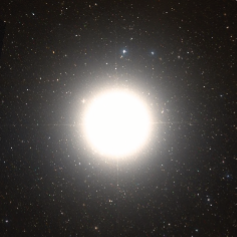
Spectral class G stars cover both class G dwarfs, like the Sun, and class G giants like Capella (Alpha Aurigae Aa).
Spectral Class G Stars
Discharge Mode for Class G Stars
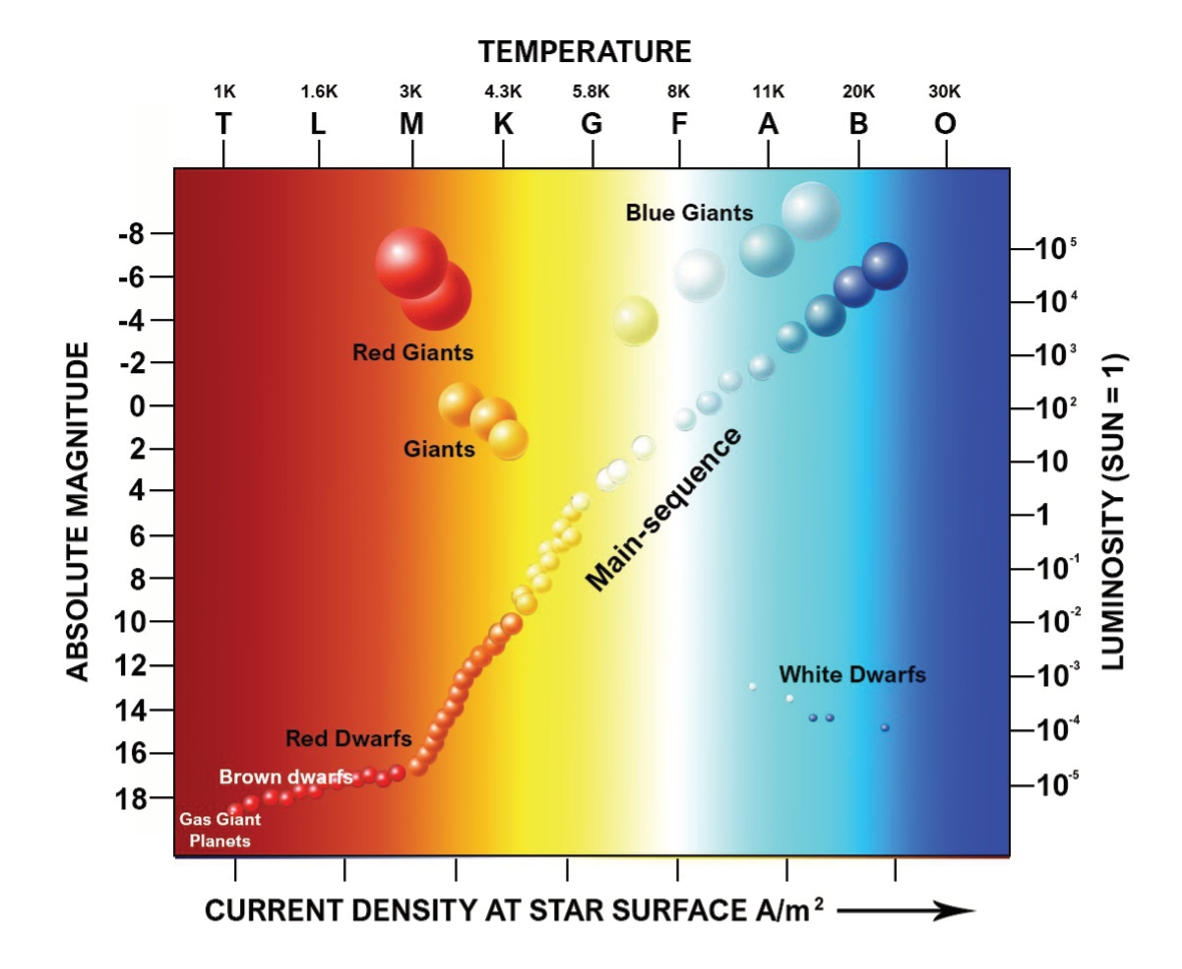
Spectral class G dwarfs sit in the glow and arc mode anode tufting discharge regime on the Electric Universe (EU) current-voltage curve—lower current density than the arc-mode A/B stars, past the transitional F-star zone. This is the spectral class where Wallace Thornhill's electric Sun model is most fully worked out, since it is built around our abiding star itself. See ‘Our Misunderstood Sun.’
The photosphere is treated as the visible surface of a glow-discharge-plus-arc-discharge double layer, with the star’s total light output largely attributed to energy delivered by the ambient galactic Birkeland current.
Class G giants
For giants in this class (e.g., the transition zone stars sitting on the red giant branch at G-type temperatures), the EU treatment follows the same pattern for class K giants: an expanded, lower-density glow-discharge sheath due to weaker powering Birkeland currents.
The Mainstream View of Class G-dwarfs
Helioseismology has mapped the Sun’s internal structure (density, temperature, rotation profile) to high precision using acoustic oscillation modes, and those measurements match a fusion-powered, gravitationally stratified interior extremely closely down to the depth of the convective zone and the core temperature needed for the proton-proton chain.
Neutrino detection (solved via neutrino oscillations after the solar neutrino problem) directly confirms fusion reactions are occurring in the solar core at the rate the standard model predicts.
The 11-year sunspot cycle and differential rotation are well-matched by dynamo models tied to the interaction between convection and rotation.
The standard solar model explains that sunspots are cooler because concentrations of strong magnetic fields block the upward flow of hot plasma via convection.