
Spectral Class M Red Giant Stars and Red Dwarfs in an Electric Universe
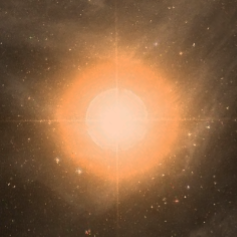
Red giant stars – Antares in Scorpius is an example.
Spectral class M stars are red giants, like Betelgeuse in Orion and Antares in Scorpius.
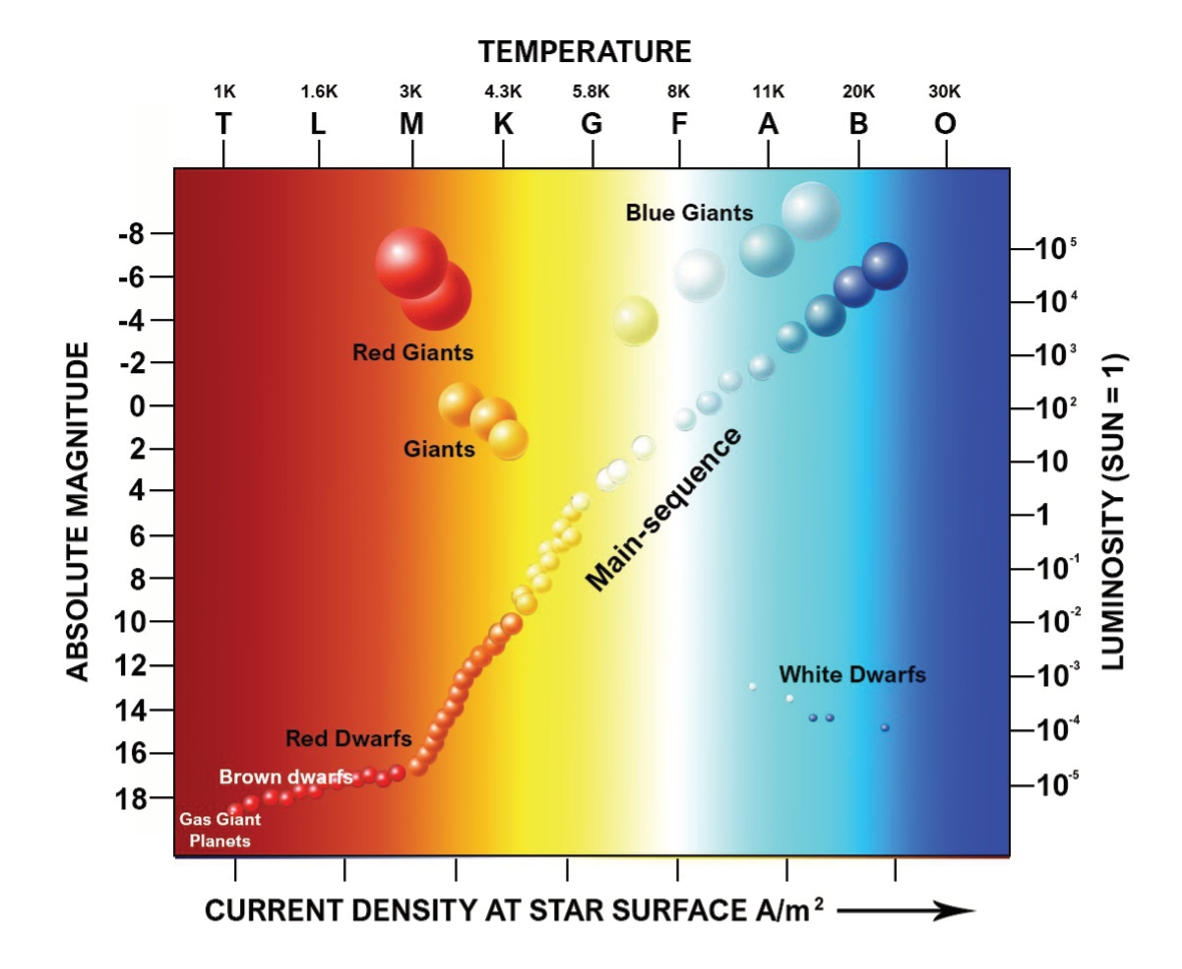
Discharge Mode for Class M Red Giant and Red Dwarf Stars
A dearth of negative charge: Class M stars cannot satisfy their hunger for electrons from the surrounding plasma due to the weak Birkeland currents powering them. So, they expand the surface area over which they collect electrons by growing a large plasma sheath that becomes the effective anode in space.
Growth process: The growth process is self-limiting; as the sheath expands, its electric field strengthens. Electrons caught up in the field are accelerated to ever-greater energies until they become energetic enough to excite neutral particles they collide with, and the huge sheath takes on a uniform red anode glow. The star becomes a red giant. The electric field driving this process also gives rise to a massive flow of positive ions away from the star. This mass loss is a characteristic feature of red giants.
Red dwarfs belong primarily to spectral class M, though the category can also include late K-type stars (K5 onward) and some early L-type ultracool dwarf stars.
See twinkle, twinkle, electric star.The Mainstream View of Class M Red Giant Stars
Red Giant Stars: Formation and Structure
Core collapse: When core hydrogen fusion stops, the core contracts under gravity.
Shell fusion: Hydrogen fusion moves to a shell surrounding the inert helium core.
Expansion: This shell fusion creates extra heat, causing the outer layers of the star to swell up to hundreds of times their original size.
Lifecycle and Fate
Lifespan: Stars spend only a small fraction of their lives in this giant phase before internal temperatures rise enough to ignite helium fusion.
End stage: Eventually, medium stars like our Sun become unstable, shed their outer layers into space to form a planetary nebula, and leave behind a dense white dwarf.