
Birkeland Currents
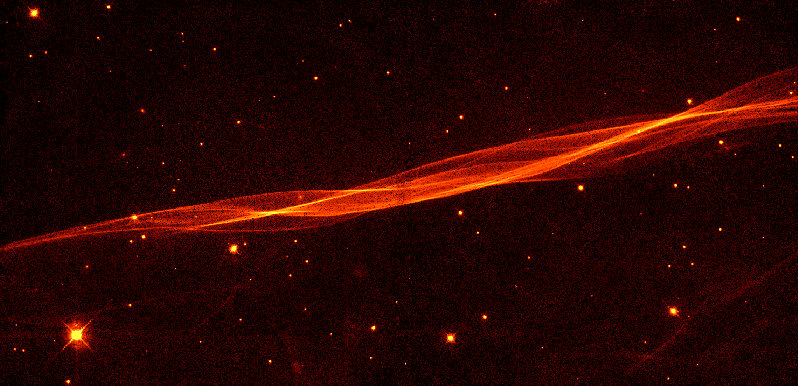
Cygnus Loop Birkeland Current. It is an understatement to say that neutral gases do not take such forms in a vacuum. Image credit: William P. Blair and Ravi Sankrit (Johns Hopkins University), NASA
Field-aligned Birkeland Currents in Space
In a plasma, charged particles such as electrons experience a Lorentz force that deflects them when moving perpendicular to a magnetic field line, causing them to gyrate around the field. Consequently, they cannot easily carry electric current across field lines.
However, electrons moving parallel to the magnetic field experience no magnetic deflection. Physicist Hannes Alfvén realized that these force-free or field-aligned currents are astronomically significant.
These field-aligned currents act as cosmic transmission lines, transferring energy across vast regions of space. The helical structure of these current pairs closely resembles the multi-stranded wires used in earthly power transmission.
When a current flows along a magnetic field in a plasma, it is compressed into long filaments by its own self-generated magnetic field. This phenomenon is known as the Z-pinch effect, named because the field direction is conventionally assigned to the z-axis in a three-dimensional coordinate system. These current filaments then twist around one another into rope-like structures called Birkeland currents, named after the renowned Norwegian physicist, inventor, and professor widely regarded as the first space scientist, Kristan Birkeland.
Electromagnetic forces help organize cosmic phenomena into spiral galaxies, axial jets, comet tails, and intricate filamentary networks—structures that are frequently visible in images from the James Webb Space Telescope. These twisted Birkeland currents are like ropes that act as markers of space electricity, exhibiting similar patterns across all observational scales.
High-energy stellar and galactic patterns captured in X-rays by space observatories like Chandra provide further support for this mechanism, as strong X-ray emissions naturally occur near energetic electric discharges.
Traditional magnetohydrodynamics (MHD) treats plasma primarily as an electrically neutral fluid. However, plasma is a distinct state of matter with complex, self-organizing electromagnetic behaviors, constituting over 99% of the observable universe. Standard astronomy texts often explain phenomena such as the Earth's ionosphere, comet tails, and the solar wind using purely kinetic or mechanical models, downplaying or omitting the broader electrical properties of plasma discharges and Birkeland currents.
Because humans live within the tiny fraction of the universe composed of dense, neutral matter on a rocky planet under a thick atmosphere, the central role of space plasmas is often overlooked.
When astronomers look deep into space, unexpected structures abound: coherent magnetic filaments hundreds of light-years long, stellar polar jets, planetary nebulae radiating unexpectedly high energies, solar magnetic activity, and X-ray emissions from comets. While standard gravitational models frequently add complex secondary hypotheses to account for these observations, electromagnetic interactions offer a direct and natural explanation for many of these active cosmic Birkeland currents and structures.