
The Great Scutum Star Cloud
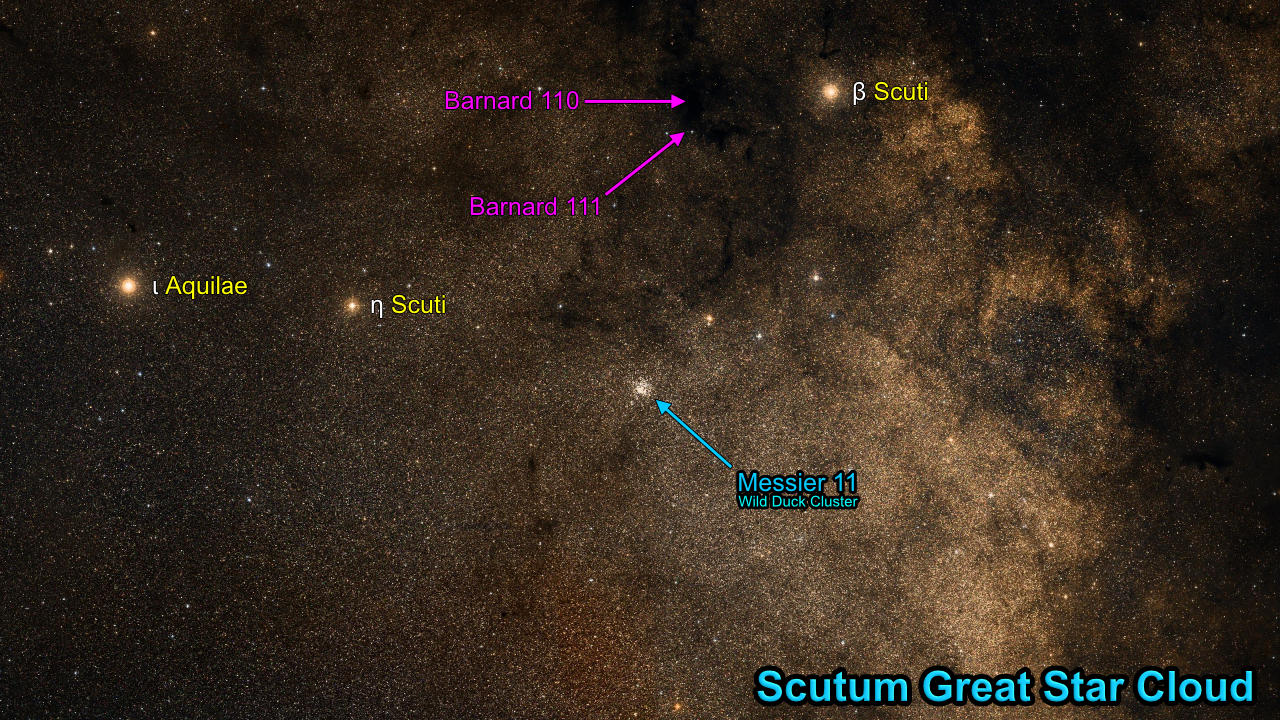
The Great Scutum Star Cloud.
The Scutum Star Cloud
The Great Scutum Star Cloud is one of the brightest and densest-looking patches of the Milky Way visible in the night sky. The American astronomer Edward Emerson Barnard described this spectacular region as “the gem of the Milky Way.”
It lies in the small constellation Scutum, the Shield, along the rich band of the Milky Way between Aquila and Sagittarius. To the naked eye under a dark sky, it appears as a large, luminous patch of unresolved starlight spanning several degrees.
Despite its name, the Great Scutum Star Cloud is not a single, physically connected cloud or cluster of stars at one particular distance. Instead, we are looking through a relatively transparent window in the interstellar dust that obscures much of the plane of our Galaxy. This low-extinction window allows us to see an unusually rich concentration of stars along the line of sight towards the inner Milky Way.
Much of the prominent stellar population seen in this direction is associated with the Sagittarius spiral arm, the next major spiral arm inward from our own region of the Galaxy. The conspicuous star field is commonly placed at around 6,000 light years from the Solar System, although stars and interstellar material visible through the window occur across a considerable range of distances, extending much farther into the inner Galaxy.
Near the northeastern edge of the Great Scutum Star Cloud lies Messier 11 (M11), the magnificent Wild Duck Cluster. Situated about 6,000 light years away, M11 is one of the richest and most compact open star clusters known, containing close to 3,000 stars.
The brilliant stellar background of the Scutum Star Cloud is crossed and bordered by numerous dark nebulae—dense clouds of interstellar dust that absorb the light of the stars behind them and appear as dark lanes, patches and cavities against the luminous Milky Way. These include Barnard 110 and Barnard 111, together with many other dark nebulae catalogued by Edward Emerson Barnard. The dark patches are not empty areas. They are foreground molecular/dust clouds silhouetted against the immense stellar background.
The contrast between the brilliant star fields and these dark clouds makes the region particularly striking. The star cloud is readily visible to the naked eye from a dark location on a clear, moonless night, while binoculars reveal an extraordinary profusion of stars and dark lanes. A telescope at low magnification provides an equally impressive view, although the broad extent of the cloud makes binoculars and wide-field instruments particularly well suited to exploring it.