Spectral Class O Stars in an Electric Universe
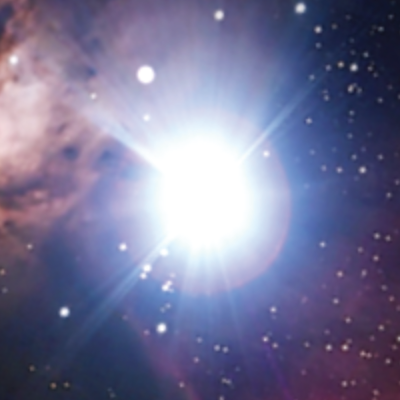
Class O stars: Zeta Orionis, Alnitak
Key Properties of Class O Stars
Temperature: Roughly 30,000 K to 50,000 K, giving them a blue-white hue, although most of their output is in the ultraviolet.
Mass: About 16 to over 100 solar masses.
Luminosity: Roughly 30,000 to over a million times the Sun's.
Diameters: Typically 6 to 15 solar diameters on the main sequence, larger for evolved giants and supergiants.
Ionizing radiation: O stars produce huge quantities of ultraviolet photons, creating H II regions (such as the Orion Nebula, powered by the Trapezium O stars).
Binarity: Most O stars have close companions, which strongly influences their evolution.
Rarity: Only about 1 in 3 million main-sequence stars in the solar neighborhood is a spectral class O star.
Spectral Features
Ionized helium: The defining feature is the presence of He II absorption lines (singly ionized helium), which require very high temperatures. This is what separates O from B stars.
Neutral helium and hydrogen: He I lines are present but weaker than in B stars, and hydrogen Balmer lines are relatively weak because most hydrogen is ionized.
Subclasses: O2 to O9.5, hottest to coolest. Classification within the type relies on the ratios of He II to He I lines, plus nitrogen and silicon features.
Luminosity classes: Added as Roman numerals (V for dwarfs, III for giants, I for supergiants). Peculiar suffixes such as "f" (N III and He II emission) and "n" or "nn" (broad lines from fast rotation) are common.
Electrical Power Source
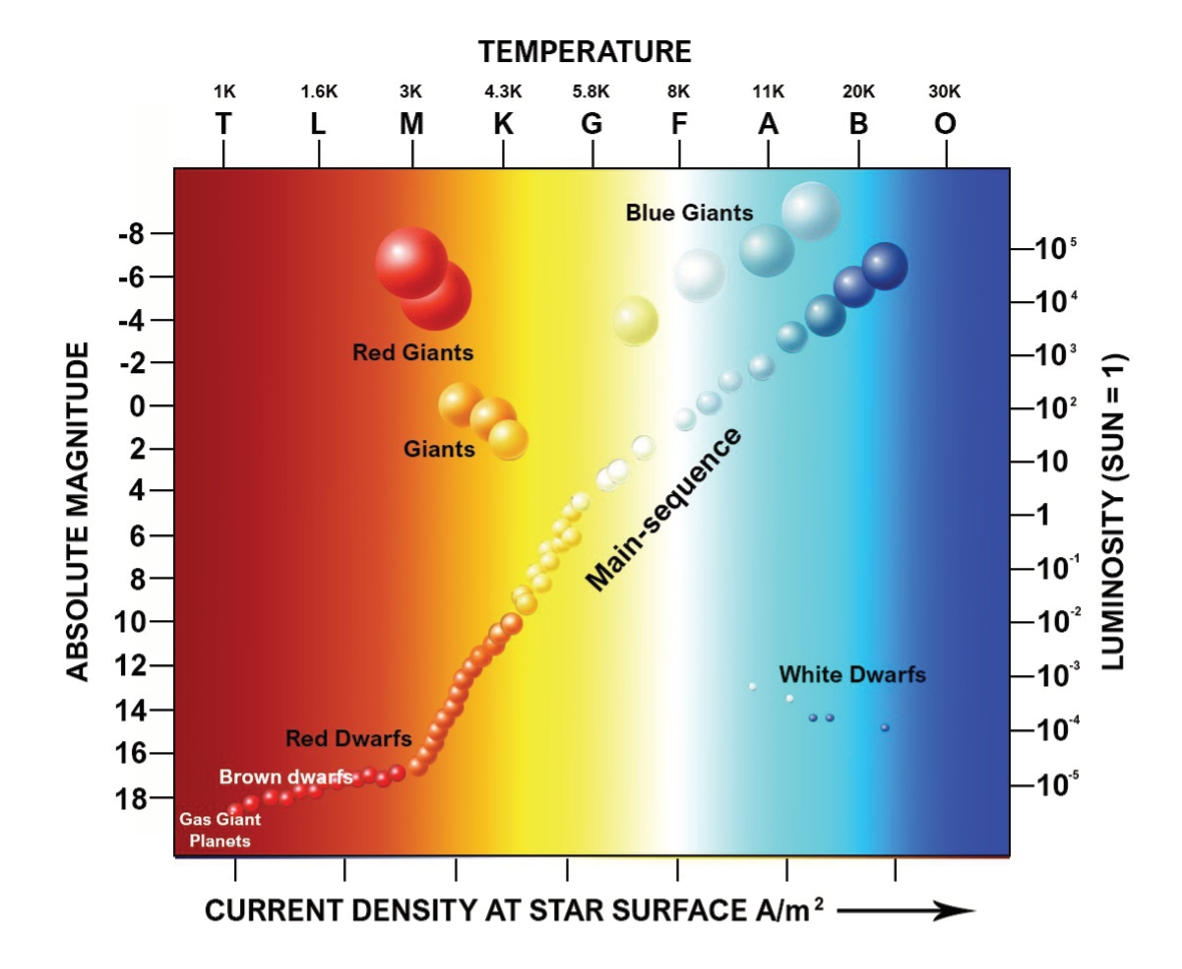
Stars are anodes in a galactic circuit, powered at least in part by current flowing through interstellar plasma along Birkeland current filaments. Spectral Class O stars have the highest current density, which explains their extreme temperature and brightness.
Class O Stars in the O-B-A-F-G-K-M Sequence
In the Electric Universe theory, the O-B-A-F-G-K-M sequence (the Harvard system of stellar classification) is a measure of electrical input (or plasma sheath conditions). Hot, class O stars, such as Zeta Orionis (Alnitak), carry the most electrical stress in the sequence. The Hertzsprung-Russell diagram is best read as a sequence of electrical excitation.
Class O Stars Luminosities
Class O stars shine brightly from their remote distances of many hundreds of light years from the Solar System due to the high-strength Birkeland currents powering them in those locations of the Milky Way Galaxy. Alnitak, a class O9.5 star, is 1,260 ± 180 light years away and shines with a luminosity of 250,000 Suns.
Outflows
The fast outflows of these star types are attributed to electric-field acceleration of ions in their plasma sheaths.
Ionized Helium Lines
The strong Helium II lines of Class O stars reflect the energetic plasma environment of a high-current discharge, not just high temperatures.
Star-forming Regions and Nebulae
Helium II regions like the Orion Nebula (Messier 42) are plasma glow discharges, powered by their electrical environment, not simply by UV photons from the Trapezium stars. Filamentary and pinched structures are discharge morphologies.
Runaway Stars
Class O stars such as Zeta Ophiuchi have been repelled or ejected by electromagnetic forces.
Star Formation
Star formation occurs along Birkeland current filaments through Z-pinch compression. Class O stars appear where such pinches are strongest.
The Mainstream View
Eclipsing and spectroscopic binaries give dynamical masses for these star types that match 16 to 100+ solar masses, independent of any assumption about the energy source.
O-type stars are found only in young regions (clusters, associations, spiral arms) and are absent from old populations. Cluster turn-off ages agree with mainstream stellar-evolution lifetimes.
Spectra are modeled quantitatively. Non-LTE atmosphere codes (CMFGEN, FASTWIND) reproduce Helium II and other line strengths from temperature, gravity, and wind parameters. The radiation-driven wind theory predicts mass-loss rates that match observations. CMFGEN (Co-Moving Frame Generator) and FASTWIND (Fast Analysis of STellar atmospheres with WINDs) are advanced, non-Local Thermodynamic Equilibrium (non-LTE) stellar atmosphere and radiative transfer codes. They model hot, massive stars (such as class O stars, Wolf-Rayet stars, and Luminous Blue Variables), incorporating spherical geometry, mass loss, and stellar winds.
The ionizing photon output of class O stars, inferred from their spectra, accounts for the observed Hα and radio emission of nebulae like Orion.
The ionizing photon output of class O stars, inferred from their spectra, accounts for the observed Hα and radio emission of nebulae like Orion.
More EU Research is Needed
Due to practically no government funding for EU theoretical science, EU accounts are largely qualitative and analogical. They have not produced numerical predictions that distinguish them from the Standard Model.
The EU model treats class O stars as the extreme end of an electrical sequence. Standard astrophysics treats them as massive, short-lived fusion-powered stars supported by mass measurements, cluster dating, and spectral modeling. The EU view is not accepted by the mainstream, mainly for lacking quantitative, testable predictions. The strongest discriminators are dynamical masses from binaries, cluster ages, and whether EU theory can model class O stellar spectra and winds numerically.
That is the challenge for the EU community. However, since when was mathematical modeling a science? Just because numbers add up to predictions does not mean they represent reality. When dealing with things too far away or that happened a long time ago, all kinds of hypotheses can be put forward. Adding cute mathematical models does not mean the hypotheses are facts. That is why the Big Bang model feels no different than a religion.