Wolf-Rayet Stars in an Electric Universe
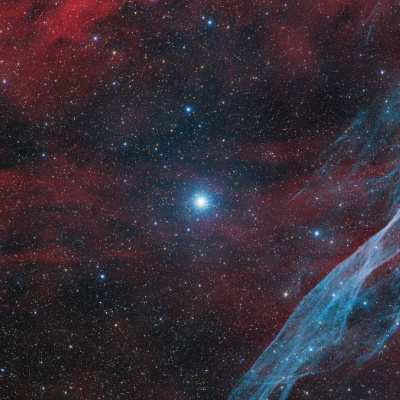
Gamma Velorum – a Wolf-Rayet star
The Mainstream View of Wolf-Rayet Stars
Named after astronomers Charles Wolf and Georges Rayet, who discovered the first three examples in Cygnus in 1867, Wolf-Rayet stars are very massive, extremely hot, short-lived stars that have blown off their outer hydrogen layers and are exposing the hot, fusion-processed material underneath.
They start life as class O stars of 20+ solar masses. Their surface temperatures run from about 30,000 K to over 200,000 K.
Wolf-Rayet stars have winds that travel at 1,000 to 3,000 km/s, and they lose mass at rates up to around a hundred-millionth of a solar mass per year, which is enormous. This stripping is what exposes their inner layers.
Instead of the dark absorption lines of ordinary stars, the spectra of Wolf-Rayet stars show broad, bright emission lines. These come from the dense, fast, expanding wind, which is itself the glowing source.
Wolf-Rayet stars are extremely bright, often hundreds of thousands to millions of times the Sun's luminosity.
Main Types
Class WN: These exhibit helium and nitrogen lines. The mainstream view is that the wind has been stripped down to material processed by hydrogen fusion (the CNO cycle).
Class WC: These Wolf-Rayet stars show carbon and some oxygen lines. Apparently, stripping has gone deeper, to layers where helium fusion has produced carbon.
Class WO: A rarer, hotter extension of WC with strong oxygen lines, likely very close to core collapse.
The Fate of Wolf-Rayet Stars
The mainstream view is that because these stars have shed so much mass and are near the end of their lives, they are expected to explode as core-collapse supernovae (types Ib or Ic, which lack hydrogen) within a few hundred thousand years. Some may collapse directly into black holes. They are also candidate progenitors for certain gamma-ray bursts. Their winds enrich the interstellar medium with heavy elements and inject enormous energy into surrounding gas, often sculpting visible nebulae around them.
Examples of Wolf-Rayet Stars
Gamma Velorum (WR 11): The closest Wolf-Rayet star to Earth, in a binary with a hot O-type companion.
WR 104: A dusty binary that appears as a spiral "pinwheel" in infrared images.
WR 124: Surrounded by the glowing Merope-like nebula M1-67, imaged by JWST:
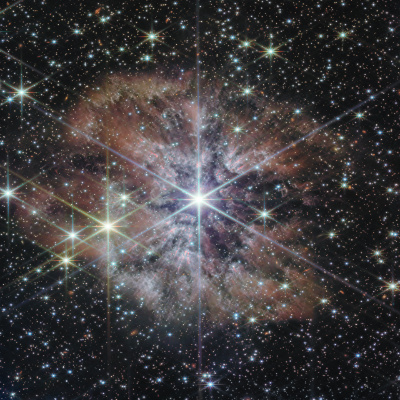
Wolf-Rayet star WR 124 (NIRCam)
Wolf-Rayet stars in Electric Universe theory
Electric Universe (EU) proponents do not accept the mainstream picture of Wolf-Rayet stars as stripped, fusion-processed cores of very massive stars. Their reinterpretation runs roughly as follows.
External power: Stars are treated as anodes in a galactic circuit, powered at least partly by electric currents flowing through interstellar plasma (Birkeland currents), not purely by internal fusion. WR stars are seen as stars under unusually high electrical stress, with a higher current density than the Sun.
Winds as electrical acceleration: The fast, dense outflows (1,000-3,000 km/s) are attributed to electric-field acceleration of charged particles, not radiation pressure on spectral lines. The Sun's solar wind speeding up with distance is cited as a smaller-scale parallel.
Emission lines: The broad, bright emission lines are the signature of a glow or arc discharge in a dense plasma sheath. The unusual WN/WC/WO line patterns reflect plasma conditions and element separation.
Nebulae and pinwheels: Ring nebulae like M1-67 around WR 124, and spiral structures like WR 104's "pinwheel" and Apep, are seen as plasma-discharge morphologies: filaments, double layers, and pinch structures.
Instability and outbursts: Eruptive behavior is attributed to electrical discharge events, such as a star shedding its sheath.
EU theory treats Wolf-Rayet stars as a showcase of electrical effects. Mainstream astrophysics regards them as radiation-driven winds and massive-star evolution. As usual, the EU claims are not accepted by the mainstream because they lack quantitative support. Come up with the math! But that's NOT science; that's mathematical modeling!