
The Z-pinch in an Electric Universe
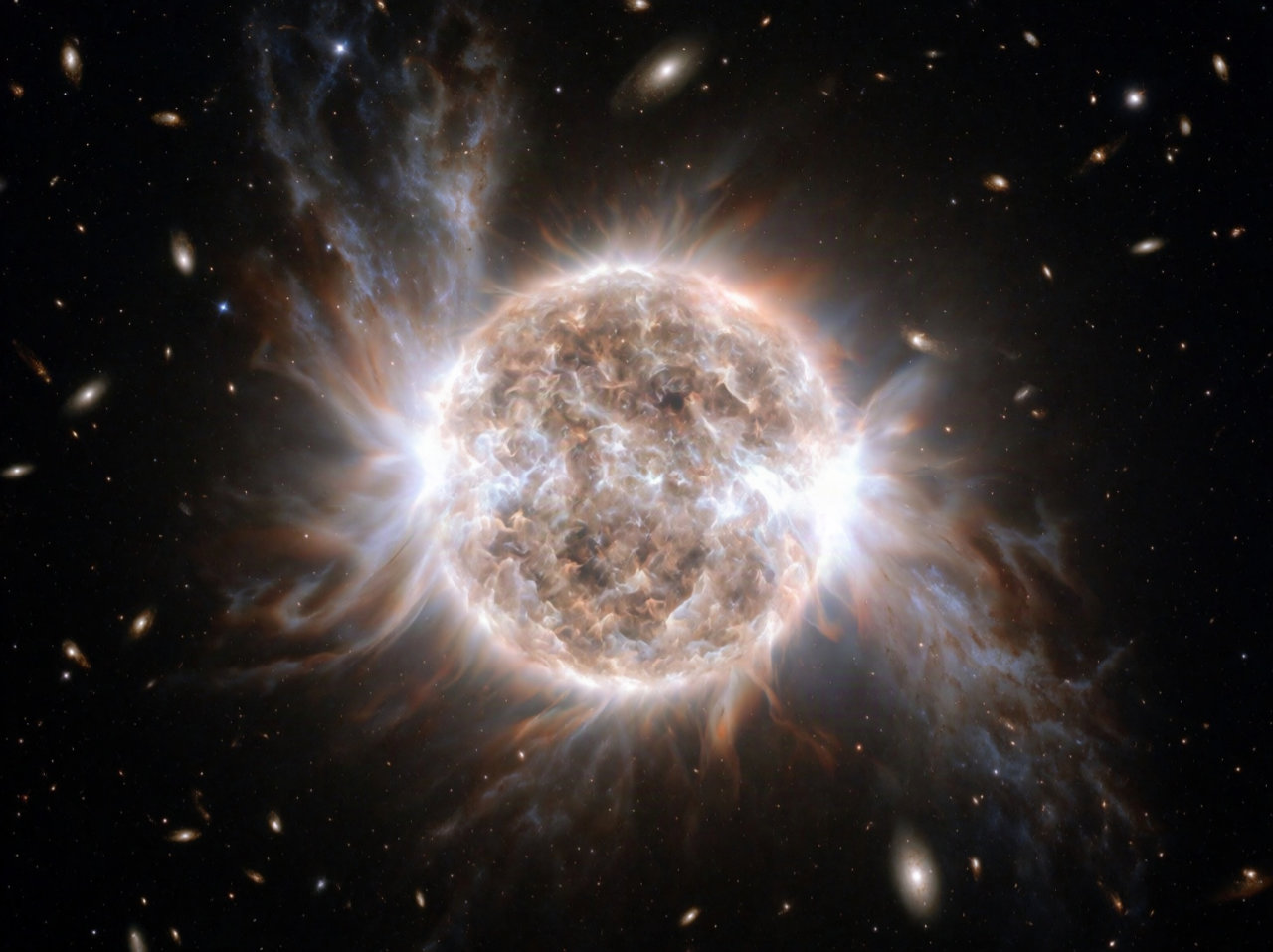
A depiction of a plasma Z-pinch creating a newborn hot star.
Plasma Z-pinch
Hannes Alfvén, who predicted that stars form by a Z-pinch along vast networks of filaments, like beads on a string, wrote... "Important fields of research, including the formation of stars, are based on a neglect of Bennett’s discovery...present-day students in astrophysics hear nothing about it."
Alfvén’s statement about students unfamiliar with the concept of electric currents in space is as true today as it was decades ago.
The Core Idea of a Z-pinch
A Z-pinch is a plasma confinement configuration in which an electric current flowing through a plasma column generates a magnetic field that squeezes the plasma inward on itself. The Bennett pinch is the equilibrium state of that arrangement, where the inward magnetic force exactly balances the outward pressure of the plasma.
How it works
The effect is self-constricting: more current gives a stronger magnetic field, which gives a stronger squeeze. The same physics makes parallel currents attract one another, since the plasma can be pictured as many parallel current filaments pulling together.
The Bennett relation
In 1934, the American scientist and inventor Willard Harrison Bennett worked out the equilibrium condition for such a column. For a steady, cylindrical pinch it ties the current to the particle content and temperature:
μ₀ I² = 8π N k (Tₑ + Tᵢ)
where I is the total current, N is the number of particles per unit length, k is Boltzmann's constant, and Tₑ and Tᵢ are the electron and ion temperatures. The equation means: for a given number of particles per unit length, there is one particular current that holds the column in balance at a given temperature. This is the Bennett pinch condition.
Why it is called a "Z-pinch"
The name comes from the geometry, using cylindrical coordinates (r, θ, z):
So the "Z" refers to the current direction, not the plasma shape. It distinguishes this device from the theta-pinch (θ-pinch), where the current flows around the circumference in the θ direction, producing an axial magnetic field that compresses the plasma from the outside. Early on, the Z-pinch was also called a "linear pinch" in contrast to toroidal designs.
Z-pinch Limitations and Instabilities
Pure Z-pinches are unstable, which is why they do not become the main route to nuclear fusion:
The Amazing Z-pinch Machine!
Despite the stability problems, the physics is useful. Fast Z-pinches are used as intense X-ray sources; for example, the amazing Z Machine at Sandia National Laboratories, which compresses arrays of fine wires and is used for high-energy-density physics and inertial fusion research. Stabilized variants (sheared-flow-stabilized Z-pinches) are also being investigated as compact fusion concepts. The same Z-pinch physics also appears in lightning channels and in laboratory spark and arc discharges.
The Mainstream View of the Z-pinch in Space
Electric Universe theory proponents invoke the Z-pinch effect as a way for plasma filaments to form and concentrate in space, including in galactic Birkeland currents. Mainstream plasma astrophysics also recognizes pinch processes (in solar flares and jets, for example), but it regards them as one effect among many within magnetohydrodynamics, in which plasma is wrongly treated as a fluid. Plasma is the first state of matter and makes up 99.5 percent of the Universe. That's the mainstream's big problem, and why increasing numbers of astronomers and astrophysicists are exploring the EU theory.