Neutron Stars
The Electric Universe (EU) theory fundamentally rejects the mainstream astrophysical model of neutron stars.
Mainstream astrophysics describes neutron stars as incredibly dense remnants of supernova explosions, where gravity has compressed matter so intensely that protons and electrons merge to form neutrons, producing an object perhaps 20 km across but with more mass than the Sun.
The Electric Universe Perspective
EU theorists, drawing particularly on the work of Wal Thornhill, Don Scott, and the writings associated with the Thunderbolts Project, argue the following:
Neutron stars do not exist as described. The notion of matter compressed purely by gravity to nuclear density is considered physically implausible, since EU holds that gravity is a far weaker and less dominant force than electromagnetism in the cosmos.
Outside the atom, neutrons decay into a proton and an electron after about 17 minutes. That means a star composed of the fictional substance called 'neutronium' cannot exist.
The neutron decay process, which is known as beta decay, is not disputed. Yet the neutron star model requires that a stellar mass of neutrons remain stable indefinitely, held in that state purely by gravitational pressure. The fictional neutronium used to describe this hypothetical neutron-dense matter has no laboratory basis whatsoever. If free neutrons cannot survive beyond roughly 17 minutes outside an atomic nucleus, the notion of an entire star composed of them is physically untenable—regardless of the gravitational pressures invoked to justify it. This is not a fringe objection; it is a logical consequence of physics that mainstream astrophysics has never satisfactorily resolved.
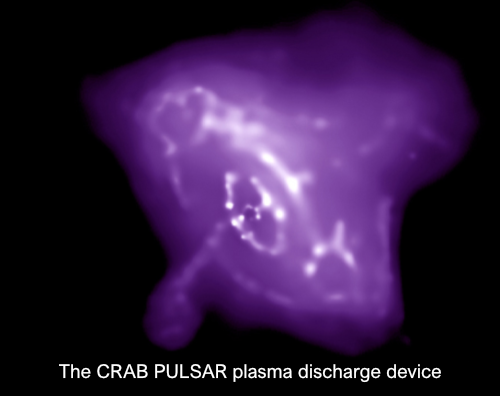
Pulsars, which mainstream astronomy interprets as rotating neutron stars emitting beams of radiation, are reinterpreted by EU theory as electrically active bodies—essentially stars in an unusual electrical state, with their pulsing behaviour explained by electrical discharge like that of a plasma focus device rather than rapid rotation of a collapsed object.
Because the electromagnetic force is orders of magnitude stronger than gravity, it must be the controlling factor in stellar behavior. What mainstream astronomers attribute to extreme gravitational collapse, EU theory attributes to plasma and electrical processes.
EU theorists argue that the mathematical models behind neutron stars are constructed to rescue a gravity-only cosmological framework, and that no direct observational evidence uniquely confirms their existence—the data can be reinterpreted through an electrical/plasma lens.
Stars themselves are regarded in EU theory as electrical discharge phenomena—essentially the visible evidence of current flowing through plasma—rather than gravitational fusion reactors. A so-called neutron star is reinterpreted as a star in an extreme electrical environment, not a collapsed gravitational remnant.
In short, the Electric Universe theory does not replace the neutron star with an alternative exotic object—it questions whether such extreme gravitational collapse is physically real at all, attributing the observed phenomena instead to plasma physics and cosmic electrical currents flowing through the galactic circuit.