
XMM-Newton Space Observatory
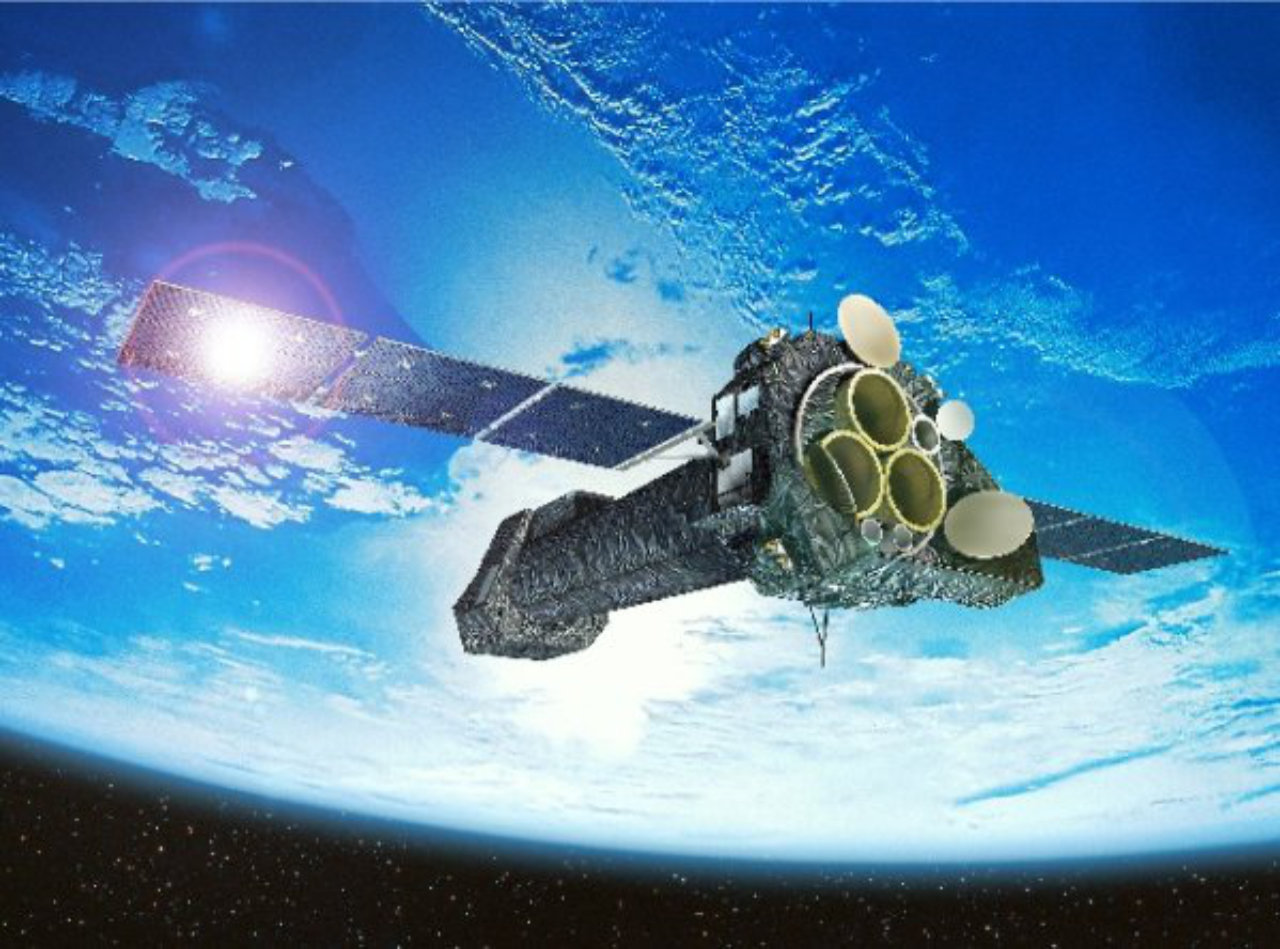
Artist's impression of XMM-NEWTON in orbit. (Image courtesy XMM-NEWTON)
The XMM-Newton Space Observatory
The XMM-Newton Space Observatory (X-ray Multi-Mirror Mission - Newton) is a highly sensitive space observatory launched by the European Space Agency (ESA). It is the largest scientific satellite built in Europe and serves as the flagship of European X-ray astronomy.
Key Details
Scientific Purpose
Because Earth's atmosphere blocks X-rays, this observatory operates in space to study the "hot" and extreme Universe. It is primarily used to investigate:
Explore the mission's latest discoveries and operational data through the NASA Science XMM-Newton page or the ESA XMM-Newton Science Operations Centre.
Despite being launched at the end of the last century with an initial 10-year design life, the XMM-Newton satellite remains in excellent health.
Current XMM-Newton Space Observatory Status and Extensions
Why Has the XMM-Newton Space Observatory Lasted So Long?
Who Uses XMM-Newton Space Observatory?
Over 5,000 international researchers and astrophysicists actively use the XMM-Newton observatory. Because it is an open-access facility, any astronomer worldwide can submit a proposal to use it. Its highly sensitive instruments have studied more than half a million X-ray sources, leading to over 6,000 published scientific papers.
The XMM-Newton Space Observatory's Chief Discoveries
XMM-Newton has profoundly reshaped our understanding of the high-energy Universe through several landmark discoveries:
Unlike traditional optical telescopes that reflect light straight back, the XMM-Newton space observatory uses a technique called grazing incidence to capture X-rays. Because X-rays are so high-energy, hitting a standard mirror head-on would cause them to pass right through it or get absorbed. To catch them, the mirrors must be positioned almost parallel to the incoming light, allowing the X-rays to skip off the surface like stones skimming across water.
XMM-Newton Space Observatory Design: 174 Gold-Coated Mirrors
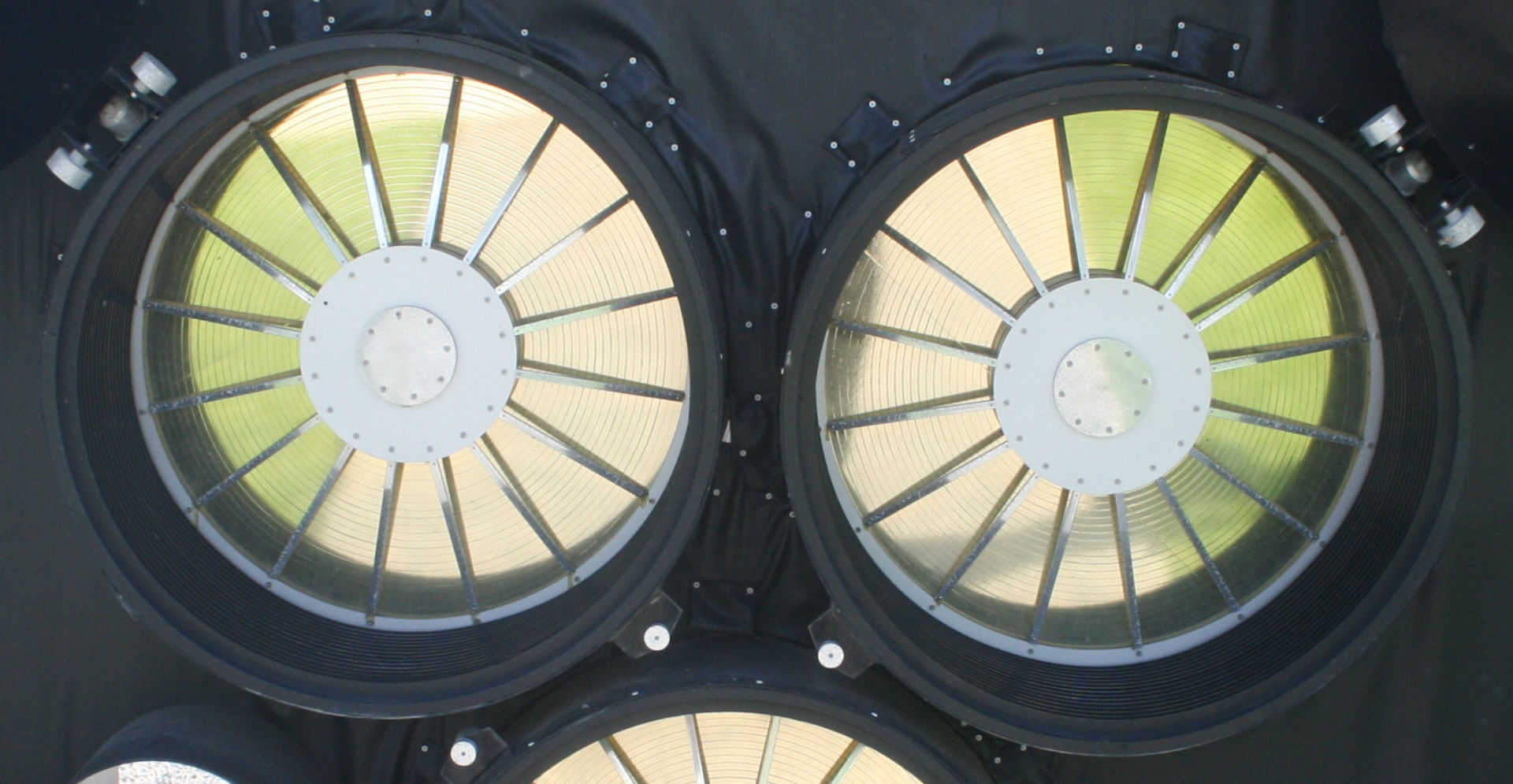
Photograph by Mike Peel (www.mikepeel.net)., CC BY-SA 4.0
To gather enough faint X-rays from deep space, the XMM-Newton space observatory relies on three identical Mirror Assemblies.
How X-Ray Light Travels Through Each Telescope
By nesting 58 mirrors together in three separate telescopes, the XMM-Newton space observatory achieves a total collecting area equivalent to a single mirror nearly 1.4 meters wide, making it arguably one of the best cosmic X-ray detectors ever built.
The XMM-Newton Space Observatory Cameras
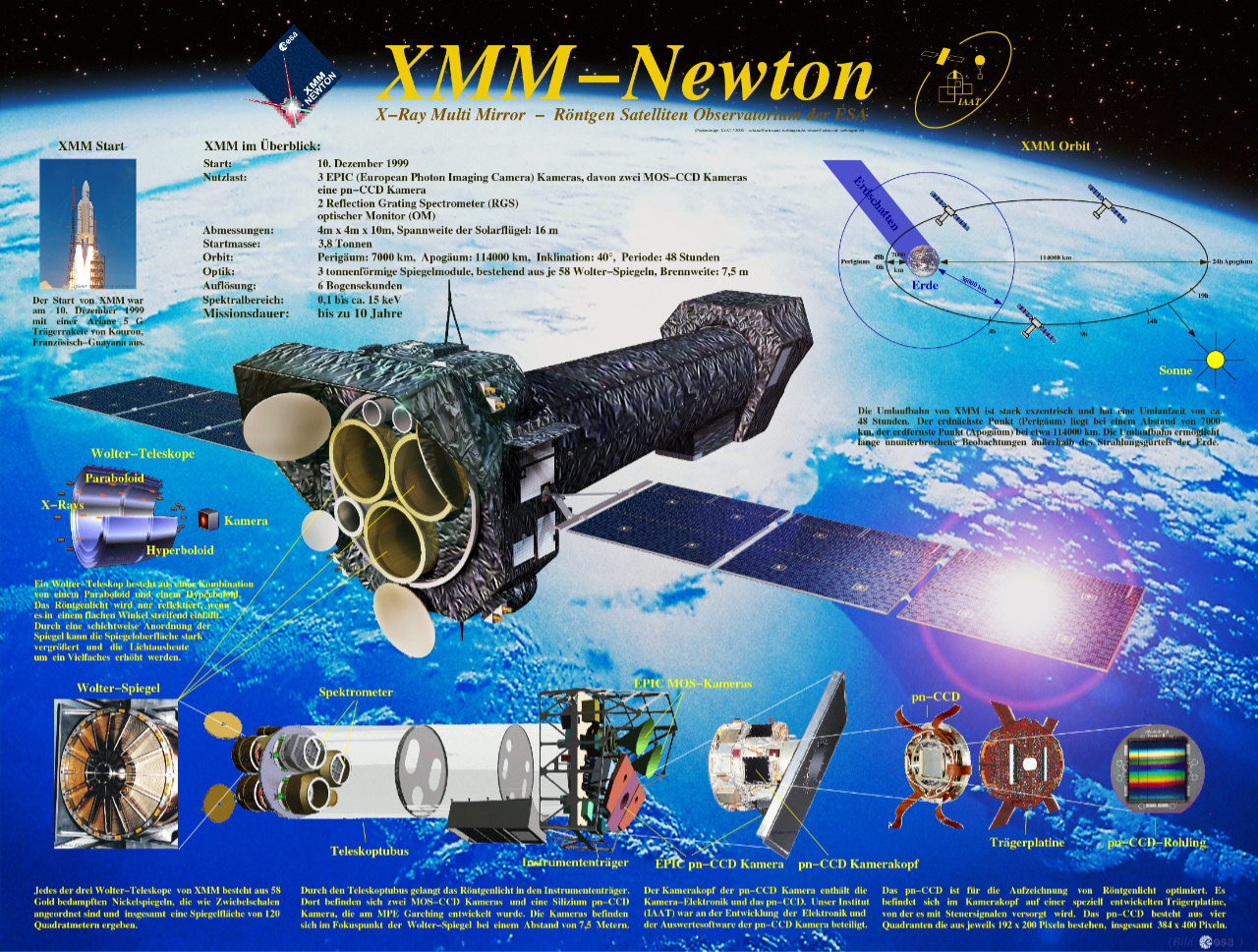
German image showing the parts of the XMM-Newton space observatory. The camera set-ups are at the bottom
At the end of XMM-Newton's 7.5-metre-long mirror tubes sits the EPIC (European Photon Imaging Camera) system. It consists of three highly sensitive cameras designed to detect and measure individual X-ray photons with incredible precision.
As glass prisms cannot split light at X-ray frequencies, XMM-Newton telescope cameras use advanced physics to simultaneously capture images, measure the X-ray energies, and record the exact arrival time of every single photon.
The EPIC-pn Camera
Located at the end of the first mirror tube, the EPIC-pn is the powerhouse of the XMM-Newton space observatory.
The Twin EPIC-MOS Cameras
The remaining two mirror tubes feed into two identical EPIC-MOS (Metal Oxide Semiconductor) cameras.
How The Cameras Work Together
All three EPIC cameras operate at ultra-cold temperatures (around -90°C to -120°C) to eliminate electronic noise. When an X-ray photon strikes a pixel on any of these sensors, it creates a small cloud of electrical charge. The camera measures the charge to calculate:
The Reflection Grating Spectrometer
The Reflection Grating Spectrometer (RGS) is the XMM-Newton space observatory’s high-resolution “prism.” While the EPIC cameras take great pictures, the RGS is built to split X-ray light into its individual wavelengths. This allows scientists to read the chemical fingerprints of the hottest objects in the Universe.
How the X-Radiation is Split
The RGS does not sit at the very end of the telescope tube—it intercepts the light halfway down.
XMM-Newton Space Observatory's View of Messier 31’s Core
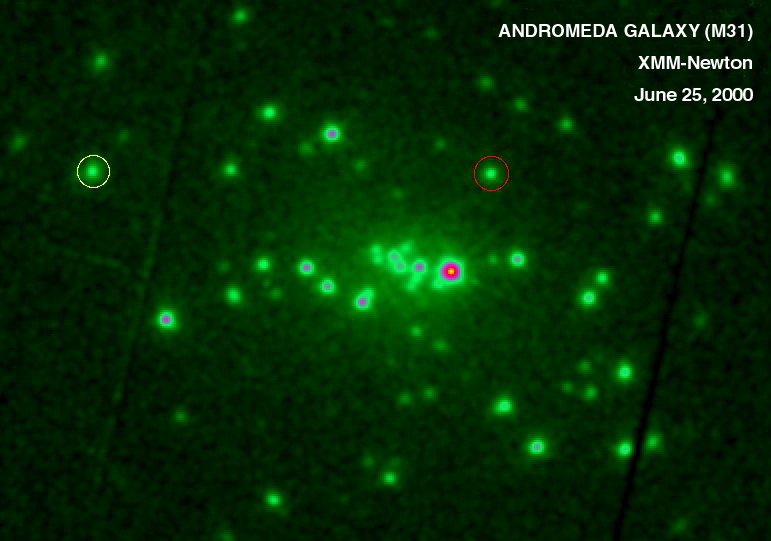
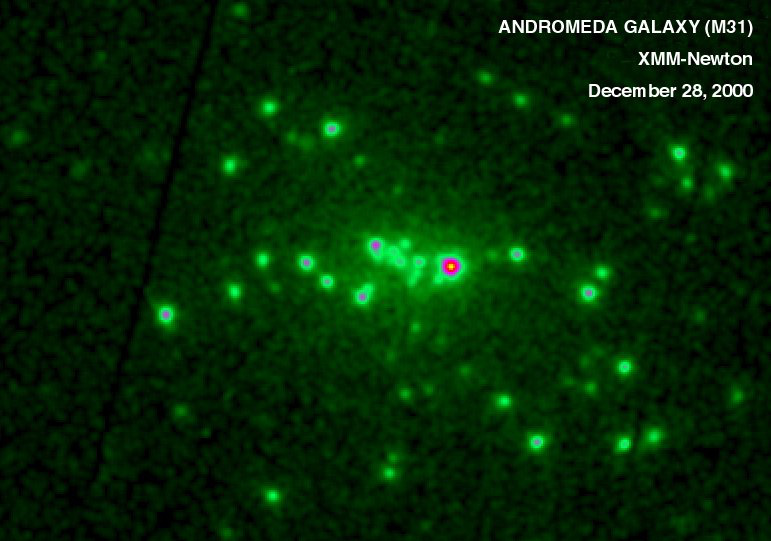
The following couple of X-ray images of the Andromeda Galaxy's nucleus were acquired in June and December 2000 with the XMM-Newton space observatory's EPIC-MOS camera. The newly discovered X-ray Nova XMMU J004234.1+411808 and a transient supersoft X-ray pulsating source are marked by red and yellow circles, respectively. (Image credit: S. Trudolyubov):
What the Reflection Grating Spectrometer Measures
By spreading the X-radiation out into a wide spectrum, the RGS acts like a cosmic thermometer and chemical analyzer. It excels at observing lower-energy ("soft") X-rays, which carry vital information about:
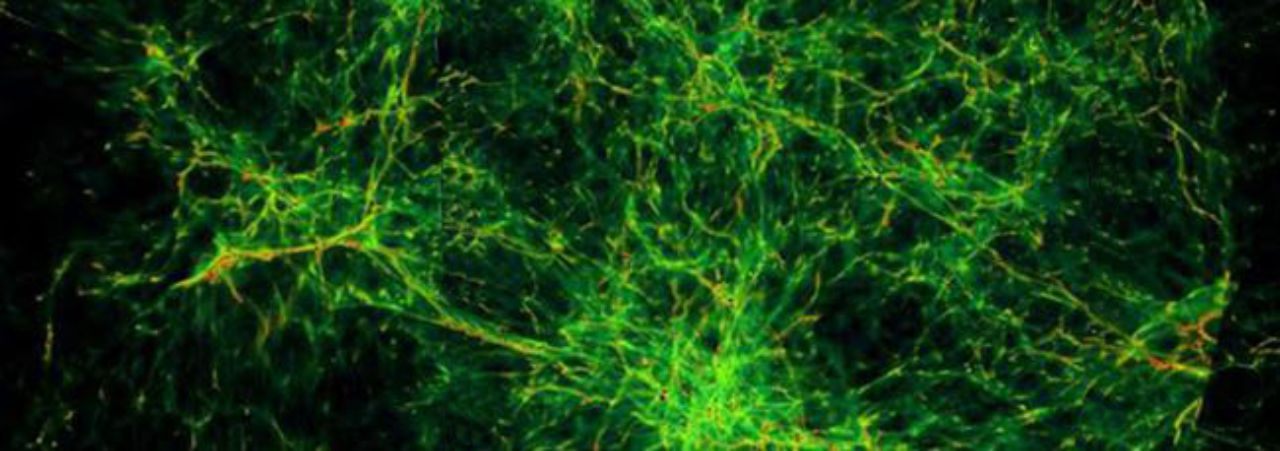
Amazing! The XMM-Newton Space Observatory Finds Missing Intergalactic Material 
After a nearly twenty-year-long game of cosmic hide-and-seek, astronomers using the XMM-Newton space observatory have found evidence of hot, diffuse 'gas' permeating the cosmos, closing a 'puzzling' gap in the overall budget of ‘normal’ matter in the Universe.
The XMM-Newton Space Observatory Optical Monitor
The XMM-Newton Optical Monitor (XMM-OM) is a dedicated 30 cm optical and ultraviolet telescope mounted alongside the three X-ray telescopes. It gives the observatory a unique ability to simultaneously observe cosmic objects in both high-energy X-rays and lower-energy visible and ultraviolet wavelengths.
Why Simultaneous Viewing Matters
Before the XMM-Newton space observatory, astronomers had to coordinate observations between different space and ground telescopes to get a multi-wavelength view of an object. Because cosmic objects change rapidly, hours- or days-long delays meant missing critical data. The Optical Monitor solves this by providing immediate context:
Key Specs of the Optical Monitor
How the XMM-Newton Space Observatory Data Is Used to Detect Elusive Dark Matter
Because dark matter does not directly absorb, reflect, or emit light, the XMM-Newton space observatory cannot "see" it directly. Instead, astrophysicists use the observatory's extreme X-ray sensitivity to map and detect dark matter through gravitational proxy mapping and by hunting for hypothetical particle-decay signatures.
Mapping "Invisible" Gravitational Wells
Dark matter accounts for roughly 85% of all matter in the Universe and clusters together to form immense, invisible scaffolding across space. Galaxies and galaxy clusters form inside these massive dark matter “halos.”
Sifting Out Dark Matter From "Missing" Matter
A major challenge in dark matter research is separating it from normal, non-luminous gas (baryonic matter) that is too faint to see.
Hunting for the 3.5 keV Sterile Neutrino "Ghost" Line
One of the most exciting ways the XMM-Newton space observatory data is used is in searching for the literal identity of the dark matter particle. A leading theoretical candidate is the sterile neutrino—a heavy, hypothetical particle that barely interacts with normal matter.
While the 3.56 keV line is highly debated and studied by the scientific community to rule out instrumental or subtle atomic anomalies, it demonstrates how XMM-Newton's high-throughput archives act as a primary tool for particle physicists seeking to crack the dark matter mystery.
Reflection Grating Spectrometer X-ray spectra
An RGS X-ray spectrum looks like a jagged line graph filled with sharp, narrow emission line spikes. Unlike the broad, smooth images captured by standard cameras, the RGS on the XMM-Newton space observatory spreads out incoming X-rays by their specific wavelength. This creates a plot that details what elements are heating up in deep space.
Elements of an RGS Spectrum
Visual Data Examples
The following image illustrates how astronomers view RGS spectrum data, showcasing actual plots that map out the physical state and chemistry of cosmic objects:
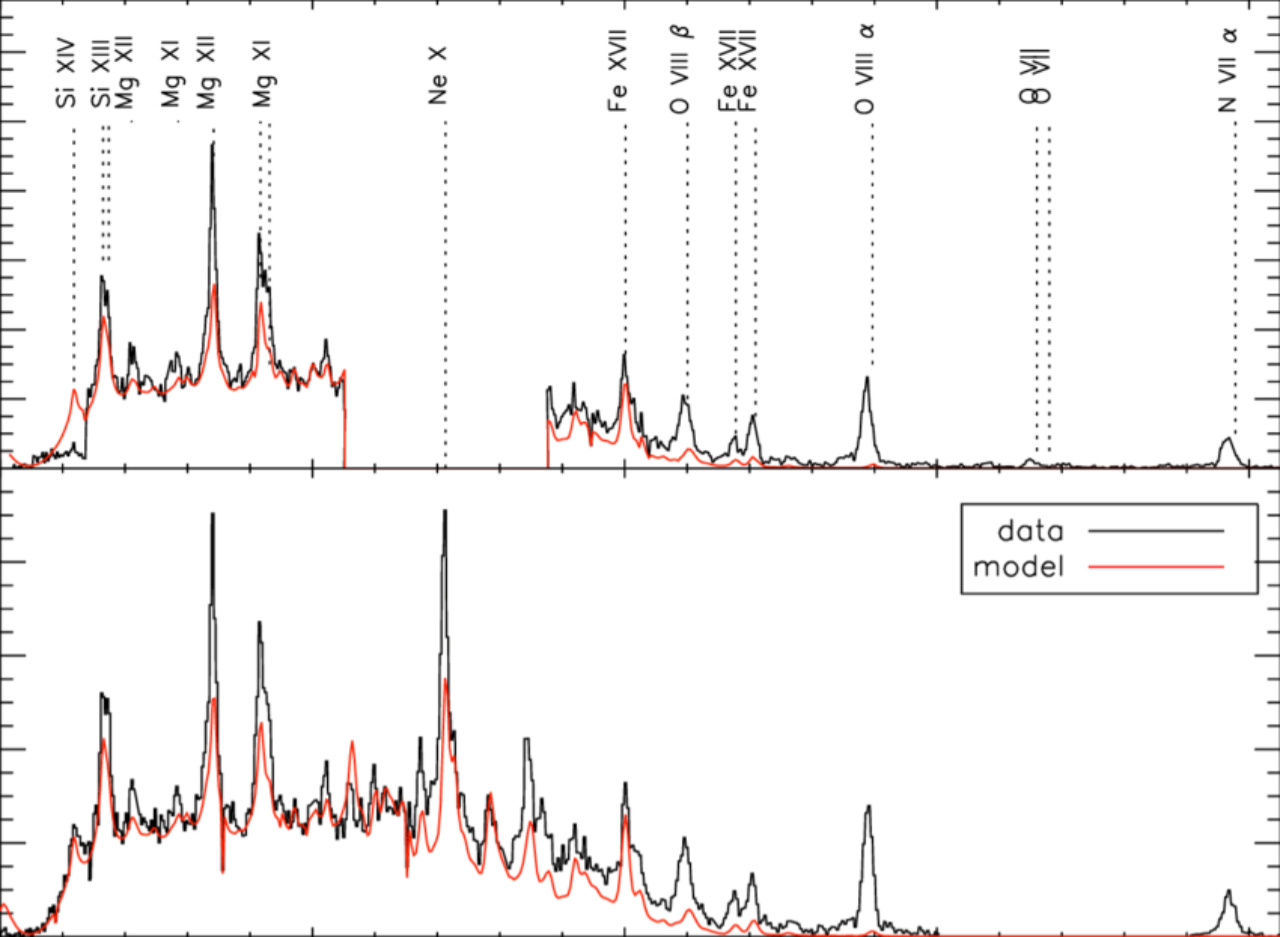
XMM-Newton space observatory data obtained with RGS (black). RGS1 data is shown in the upper panel, and RGS2 in the lower panel. Again, note the differing y-scale ranges in each panel. The multi-temperature APEC model used for the Chandra data is clearly a much poorer fit to the RGS data. In particular, oxygen and nitrogen features are poorly accounted for by the model. An additional low-temperature component is inconsistent with the observed H-like to He-like line ratios. The enhanced O and N features are consistent with X-ray emission from the nova ejecta.
How Astronomers Read Specific Spikes to Calculate the Speed of a Supernova Explosion
Astronomers calculate the speed of a supernova explosion by measuring how much these specific spikes shift away from their normal position on the graph. This process relies entirely on the Doppler Effect, the same physics principle that causes an approaching ambulance siren to sound high-pitched and a receding siren to sound low-pitched.
Because the gas from an exploding star is expanding rapidly in all directions, some of the debris rushes directly toward Earth, while the debris on the far side rushes away.
Finding the "Rest Wavelength"
Every chemical element has a unique atomic fingerprint. In a stationary laboratory on Earth, an element like ionized Iron (Fe)or Oxygen (O) will always emit a sharp spike at one exact, known position on the graph. For example, a specific type of glowing oxygen gas always emits light at a rest wavelength of exactly 18.97 Angstroms. This serves as the astronomer's baseline.
Measuring the Shift
When XMM-Newton's RGS instrument captures data from a supernova, astronomers look closely at that oxygen spike:
Calculating the Speed
Because the explosion expands in a sphere, the single sharp spike spreads out and blurs into a wide, broad bump. The width of this broad peak tells astronomers the maximum shift in wavelength:

By measuring how wide the base of the peak is, astronomers can calculate exactly how fast the gas is expanding. Using this data, the XMM-Newton space observatory has clocked supernova debris tearing through space at staggering speeds of over 10,000 kilometers per second.
How This Data Reveals the Age of a Supernova Remnant
Astronomers cannot look at a single RGS spectrum and read a simple clock. Instead, they use the chemical spikes and the expansion speed to calculate the age of a supernova remnant using two distinct methods: backtracking the expansion or measuring chemical ionization time.
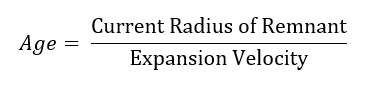
Method 1: The "Rewind the Tape" Calculation
This is a geometric calculation that requires combining XMM-Newton's expansion speed data with a physical image of the remnant.
Method 2: The "Atomic Clock" (Ionization Age)
When a star explodes, a violent shockwave rips through the surrounding space gas. This gas is instantly heated to millions of degrees, ionizing atoms.
By combining these two methods, the XMM-Newton space observatory can determine if a supernova remnant is a young "baby" exploded just a few hundred years ago (like the remnants of Kepler's or Tycho's supernovae) or an ancient structure that has been expanding for tens of thousands of years.
How the Temperature of The Supernova Explosion is Calculated
Astronomers calculate the temperature of a supernova explosion by measuring the ratios between different chemical spikes on the RGS spectrum graph. This technique relies on the fact that as an exploding star gets hotter, its atoms lose further electrons, altering the specific wavelengths of X-ray light they can emit.
The Physics: Stripping the Atoms
Because the explosion expands in a sphere, the single sharp spike spreads out and blurs into a wide, broad bump. The width of this broad peak tells astronomers the maximum shift in wavelength:
The Calculation: Comparing Spike Heights
To find the exact temperature, astronomers do not look at how tall a single spike is. Instead, they divide the height of one chemical spike by the height of another.
Fine-Tuning with Computer Models
Once astronomers have the ratio between the spikes, they plug the numbers into a digital plasma simulation code (such as SPEX or XSPEC).
The software simulates a virtual cloud of gas and adjusts its temperature until the simulated peaks perfectly match the real-world jagged line captured by XMM-Newton. This method allows astronomers to measure interstellar gases cooking at precise temperatures anywhere from 1 million to over 100 million K.X-Ray Spectra Provide the Sharpest Image to Date of a Rapidly Spinning Black Hole
The X-Ray Imaging and Spectroscopy Mission (XRISM), a joint mission between the Japanese Aerospace Exploration Agency (JAXA) and NASA, launched on Sept. 7th, 2023. Its advanced imaging filters and spectrometers were designed to study black holes and neutron stars and detect the hot plasma in the intergalactic medium.
Alongside the European Space Agency's (ESA) X-ray Multi-Mirror Mission Newton (the XMM-Newton space observatory) and NASA's Nuclear Spectroscopic Telescope Array (NuSTAR), XRISM has provided the sharpest-ever X-ray spectrum of the iconic MCG–6-30-15.
Located 120.7 million light years away, this Type 1 Seyfert galaxy is noted for its variable X-ray spectrum and a central supermassive black hole (SMBH), estimated to be about 2 million solar masses.
The research team, led by Laura Brenneman of the Harvard & Smithsonian Center for Astrophysics (CfA), has managed to isolate the broad iron emission line and the associated "reflection" that are indicative of a rapidly-spinning SMBH. Thanks to XRISM's unmatched spectral resolution, the team was able to study the black hole's immediate environment (which includes an accretion disk that extends close to its event horizon).
For some time, astronomers have suspected that a large fraction of the X-ray emissions coming from this galaxy originates from matter very close to the galaxy's SMBH. However, previous X-ray telescopes have lacked the resolution to separate the various emission and absorption lines in this energy range, preventing them from investigating this theory.
In regions that are close to an SMBH's event horizon, gravity radically alters the curvature of spacetime (consistent with Einstein's Theory of General Relativity), making it hard to separate light signals originating near the event horizon from more distant gas clouds.
By combining ultra-high resolution data from XRISM's "Resolve" X-ray instrument with the broadband power of the XMM-Newton space observatory and NuSTAR, the team obtained data that allowed them to separate the emission and absorption lines from these two sources.
As Brenneman explained in a CfA press release:
"Astrophysical black holes have only two properties: mass and spin. We can estimate their masses by several different means, but measuring their spins is much harder and requires collecting data from gas that is orbiting the black hole immediately outside the event horizon. For supermassive black holes in active galactic nuclei, this is best accomplished by obtaining X-ray spectra with high signal-to-noise and spectral resolution."The study, which was recently published in The Astrophysical Journal, confirmed the presence of a warped iron emission line in the X-ray spectrum. This has provided the first evidence of material orbiting at close to the speed of light near the event horizon rather than outflowing winds between Earth and the galaxy.
This region, they suggest, produces about 50 times as much X-ray reflection as more distant gas clouds. A companion study led by co-author Daniel R. Wilkins of Ohio State University, recently submitted to The Astrophysical Journal, builds on these results by analyzing the spectra at different times of observation.
According to Brennerman, these results show how astronomers can use XRISM to confirm and refine previous measurements of black hole spin rates obtained from lower-resolution X-ray spectra. Their study also revealed crucial data about the SMBH's corona, the billion-degree region that extends above and below the accretion disk. This region is responsible for producing most of an SMBH's X-ray emission and has long been a mystery in astrophysics.
Their study has also revealed at least five distinct zones of a wind created and driven by accretion onto the black hole. Said Brennerman:
"We want to go back and look at all of the sources for which we have lower-resolution spectra and observe them with XRISM, and say, 'Okay, now that we're confident we can separate the narrow and the broad features, how accurate were our previous spin measurements?'
"Understanding these winds in addition to the black hole's spin is important because they can tell us how galaxies grow and evolve, either primarily by collecting gas or by mergers with other galaxies and black holes. So, measuring these two quantities accurately gives us a holistic view of the symbiotic relationship between supermassive black holes and their host galaxies."
[Comment]
Astronomers and astrophysicists worldwide continue to believe the Big Bang theory, relativity, the existence of black holes, neutron stars, expanding space-time, and other invented notions such as dark matter and energy, because these concepts help keep the standard cosmological model from falling apart.
The impression is that the tools used by astronomers, such as the XMM-Newton space observatory, are technically superb and operate marvelously. However, the people using those instruments misinterpret the data acquired.
Instead of having the courage to admit that the gravity-centered standard cosmological model is seriously flawed and go back to the drawing board, they simply carry on hypothesizing, forcing awkward data to fit their precious model rather than questioning the model itself.
It is as if what they have been taught is the absolute truth, and so they must continue acquiring more data to help convince themselves and their peers that their interpretations comply with mainstream cosmological orthodoxy.
The XMM-Newton observatory is oversubscribed because new hypotheses must constantly be generated to account for data that the standard model cannot adequately explain.
That missing explanatory power is essentially fundamental.
It is the overwhelming electrical nature of the Universe that is absent from the standard model.
So, they misinterpret exploding plasma double layers as supernovae explosions.
They need to scientifically define 'energy' and 'mass' before presuming to formulate a cosmological model.
Nature is fundamentally simple and efficient. It does not do things the hard way. It is the result of the interplay of positive and negative charges.